What Can You Reuse in a Major Home Renovation? A North Shore Homeowner’s Guide
Many materials in an older North Shore home are worth keeping. Structural framing, solid wood flooring, quality cabinetry, and some plumbing fixtures can survive a full renovation and perform just as well in the new design. The decision about what to salvage versus replace depends on the material’s condition, where it sits in your renovation scope, and whether keeping it actually saves money once labour is factored in. On a large-scale project, getting this call right early can meaningfully shape both your budget and your timeline.
Key Takeaways
- Structural elements like posts, beams, and framing lumber are often reusable if they pass a professional inspection for moisture damage and structural integrity.
- Solid wood flooring, original fir doors, and quality hardwood trim can frequently be refinished rather than replaced, preserving character and reducing waste.
- Cabinetry boxes in good condition can be refaced or repainted, saving significant material costs while still achieving a fresh look.
- Plumbing fixtures, windows, and appliances require closer evaluation: age, efficiency ratings, and code compliance all affect whether reuse makes sense.
- Salvaged materials can have a resale or donation value, which partially offsets disposal costs for items you cannot reuse on-site.
- Working with an experienced contractor early helps identify what is worth keeping before demolition begins, since decisions made at this stage cannot be undone.
Things You Must Know
1. Reuse Decisions Need to Happen Before Demo, Not After
Once a wall comes down or a floor gets torn up, the window for careful salvage closes quickly. On any major renovation, a thorough pre-construction assessment should identify which materials are candidates for reuse, which need testing (for asbestos or lead paint in older homes), and which should be set aside carefully during demolition. Rushing this step is one of the most common ways homeowners lose material value they could have kept.
2. Not Everything That Looks Fine Actually Is
A cabinet door that looks solid may be hiding a warped box behind it. Flooring that appears level may have subfloor moisture damage underneath. Framing that seems intact can carry decades of hidden rot in a region like the North Shore, where rainfall and humidity put real pressure on building envelopes. A professional inspection before committing to reuse protects you from discovering problems mid-project, when correcting them costs significantly more.
3. Labour Cost Is Part of the Reuse Equation
Salvaging materials is not always cheaper than replacing them. Carefully removing and storing original flooring, then reinstalling it after subfloor work, takes skilled labour and adds time. In some cases the labour cost of saving a material exceeds the cost of a comparable new product. An experienced contractor can give you an honest assessment of which reuse decisions genuinely save money and which ones feel economical on paper but add cost in practice.
Which Structural Elements Are Worth Saving?
In most large-scale renovations, the primary structure stays. Load-bearing walls, foundation elements, and major floor assemblies are typically retained unless the scope includes a full reconfiguration. What changes more often are the interior partitions, the finishes, and the mechanical systems running through the structure.
Exposed timber posts and beams are worth salvaging almost every time. Old-growth Douglas fir, which appears in many North Shore homes built before the 1980s, is denser and more durable than comparable new lumber. If the members are structurally sound, a good carpenter can clean, sand, and reintegrate them into the new design, often as a feature rather than something to hide.
Framing lumber from interior walls is more variable. Dimensional accuracy, moisture content, and any prior pest activity all affect whether it is worth the time to pull, denail, and restack it for reuse. Your contractor should assess this during the pre-construction review.
Flooring: Where Reuse Often Makes the Most Sense
Solid hardwood flooring is one of the strongest candidates for reuse in any renovation. Unlike engineered or laminate products, solid wood can be sanded and refinished multiple times over its life. Original fir floors, which are common in North Vancouver and West Vancouver homes from the mid-20th century, frequently come out of a renovation looking better than anything available new at a comparable price.
The main conditions for reuse are board thickness (there needs to be enough material left for sanding), uniformity of damage, and subfloor condition. If the subfloor has moisture issues, those need to be resolved before any flooring goes back down, original or new.
Refinishing existing hardwood flooring typically costs between $3.50 and $6.50 per square foot, while full hardwood floor replacement often ranges from $8 to $15 or more per square foot installed, according to 2026 cost data — making it one of the higher-return reuse decisions in residential renovation.
Cabinetry: Reface, Repaint, or Replace?
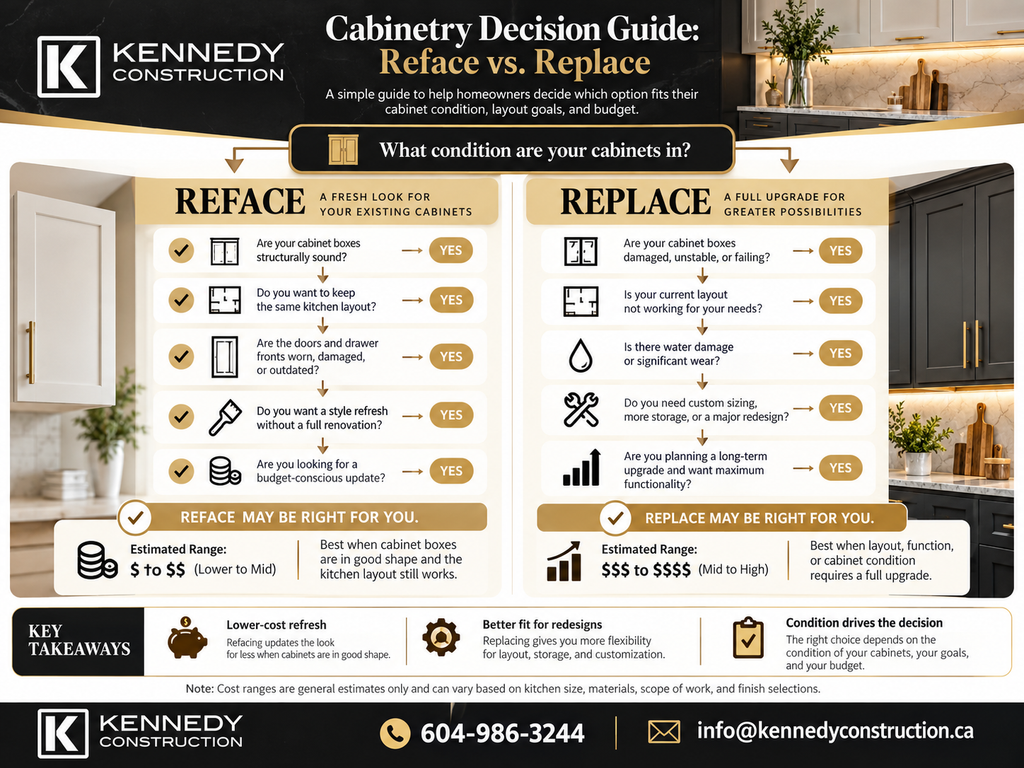
Kitchen and bathroom cabinetry is expensive, and the boxes (the structural carcasses) often outlast the doors and hardware by decades. If the boxes are plumb, square, and free of water damage, refacing or repainting them can deliver a near-complete visual transformation at a fraction of full replacement cost.
The cases where replacement makes more sense include a layout reconfiguration, significant size changes, or box damage from a leak or extended moisture exposure. If the renovation involves moving plumbing or reconfiguring the kitchen footprint, keeping the old cabinet positions may not be practical anyway.
Windows, Doors, and Hardware
Original solid wood interior doors are almost always worth saving. They tend to be heavier, better constructed, and more dimensionally consistent than most new hollow-core replacements. Refinishing them or updating hardware gives a noticeably different result at a much lower cost. The same applies to original millwork, baseboards, and trim profiles, particularly in heritage-style North Shore homes where matching profiles are difficult and expensive to source new.
Exterior windows are a different calculation. Older single-pane or early double-pane units may be structurally intact but thermally inadequate for today’s expectations. In a climate like the North Shore, where winters are damp and heating costs are a real concern, upgrading to higher-performance windows during a major renovation is usually the better long-term decision, even if the existing frames appear fine.
Window and door upgrades are frequently cited among the renovations with strong combined returns in home value and energy cost reduction — according to industry cost-value research, homeowners typically recoup 60–70% of their investment at resale, while in coastal climates where building envelope performance directly affects heating loads and moisture management, the long-term energy savings add further to that return.
Plumbing, Electrical, and Mechanical Systems
These are the areas where reuse requires the most caution. The visible condition of a pipe or panel tells you very little about its remaining service life or code compliance. On a large-scale renovation, opening walls and ceilings creates an opportunity to upgrade mechanical systems that would otherwise be inaccessible for another decade or more. Passing up that opportunity to save the cost of a new hot water heater or an outdated electrical panel is rarely the right trade-off.
That said, some plumbing fixtures (quality cast iron tubs, stone sinks, solid brass faucets) have a long useful life and can be reinstalled or repurposed in another part of the home. Copper supply piping in good condition with no signs of pitting or corrosion is generally worth retaining. Your contractor and plumber should make that call together based on a physical inspection.
Reusable vs. Replace: A Quick Reference
| Material or Element | Typically Reusable? | Key Condition Check |
| Solid wood flooring | Yes, often | Board thickness, subfloor moisture |
| Structural posts and beams | Yes, if inspected | No rot, no pest damage, structural integrity |
| Interior solid wood doors | Yes, usually | No warping, hinges and hardware reusable |
| Cabinet boxes (carcasses) | Often, if layout stays | Square, no water damage, no layout change |
| Original millwork and trim | Yes, high value | Profile intact, no cracking or splitting |
| Exterior windows | Rarely on major renos | Thermal performance, seal integrity, age |
| Plumbing supply piping (copper) | Sometimes | No pitting, corrosion, or prior repairs |
| Electrical panels and wiring | Rarely on major renos | Age, capacity, code compliance |
What Happens to Materials You Cannot Reuse On-Site?
Not everything salvageable belongs in the same home. Fixtures, appliances, cabinetry, and architectural elements that do not fit your renovation can often be donated to Habitat for Humanity ReStores or sold through salvage dealers. This reduces landfill waste and can offset disposal costs.
The choice of materials throughout your renovation, including what you keep and what you bring in new, has a real environmental footprint. Thoughtful salvage planning is one of the more practical ways to reduce that footprint on a large project without compromising on quality or performance.
Construction and demolition waste represents a substantial share of total landfill volume in Metro Vancouver — Metro Vancouver’s own data shows that material from construction, demolition, and renovation makes up one-third of the waste sent to landfills in the region, and deconstruction-focused approaches that prioritize salvage over disposal are increasingly supported by municipal sustainability programs across the region.
How to Approach Salvage Planning on a Large Renovation
- Schedule a pre-construction walkthrough with your contractor. Identify materials worth keeping before any demolition plan is finalized. This is the point at which salvage decisions cost nothing extra.
- Test for hazardous materials in homes built before 1990. Asbestos in floor tile adhesive, pipe insulation, and ceiling texture, as well as lead paint on older trim, must be identified and handled by certified professionals before any disturbance.
- Plan your storage. Salvaged flooring, doors, and millwork need dry, protected storage during construction. Factor that into your site logistics early.
- Mark what stays and what goes before demo begins. Walk the space with your contractor and physically tag materials. Confusion during demolition is how good material gets damaged or lost.
- Coordinate with your trades. Plumbers and electricians need to know which existing rough-in elements are being retained so they plan around them rather than cutting through them.
- Arrange disposal or donation for what leaves the site. Line up your salvage outlet or ReStore pickup before demo, not after you have a pile of material sitting on the driveway.
Common Mistakes to Avoid
- Assuming a material is reusable based on appearance alone, without a professional inspection for hidden damage.
- Waiting until mid-demolition to decide what to keep, when salvage is far more difficult and costly.
- Keeping original mechanical systems to save upfront cost when the renovation provides direct access for an upgrade that would otherwise require reopening walls later.
- Underestimating the labour required to carefully remove and reinstall salvaged materials, which can erase the anticipated savings.
- Skipping hazardous material testing in pre-1990 homes before any demolition begins.
- Failing to store salvaged materials properly, leading to damage that makes them unusable by the time reinstallation comes.
Frequently Asked Questions
How can you reuse materials in your home renovation?
Start with a pre-demolition assessment to identify which materials are structurally sound and worth keeping. Common approaches include refinishing solid wood floors instead of replacing them, refacing cabinet boxes with new doors, reinstalling original trim and millwork, and repurposing solid wood doors. Materials that cannot stay in the home can sometimes be donated or sold through salvage outlets. The key is planning this before demolition begins, not after.
What materials can be reused in construction?
Solid wood flooring, structural timber, interior solid wood doors, original millwork and trim, cabinet carcasses, copper plumbing piping, and quality masonry are the most commonly reused elements in residential construction. Mechanical systems, windows, and electrical components require closer evaluation before reuse, particularly in major renovations where code compliance and performance expectations are higher.
How do you reuse waste materials at home during a renovation?
Leftover lumber can be used for blocking, backing, or framing in other parts of the project. Offcut tile often works for smaller areas or utility spaces. Salvaged fixtures and cabinetry removed from one area can sometimes be repurposed elsewhere in the home. Materials that do not fit the project can be donated to a ReStore or sold to an architectural salvage dealer rather than sent to landfill.
What are some examples of materials commonly reused in home renovations?
Solid hardwood flooring is probably the most common, followed by structural beams and posts, interior solid wood doors, original baseboards and trim profiles, cabinet boxes, stone sinks and cast iron tubs, solid brass hardware, original brick, ceramic or stone tile, and copper supply piping. In heritage homes, decorative elements like original mantels or built-ins also have strong reuse value, both functionally and for preserving character.
Does reusing materials in a renovation actually save money?
It depends on the material and the labour involved. Refinishing existing hardwood flooring is typically less expensive than full replacement with a comparable product. Keeping cabinet boxes and refacing them saves significant material cost. However, carefully removing, storing, and reinstalling materials takes skilled labour, and that cost needs to be part of the calculation. A contractor experienced in large-scale renovations can help you identify where reuse genuinely saves money versus where it adds cost for a marginal benefit.
Making the Right Call Before Your Renovation Starts
The materials already in your home represent real value. Whether that value is better realized through reuse, salvage and donation, or straightforward replacement depends on condition, scope, and an honest assessment of the labour involved. Getting that answer right before demolition begins is one of the more important conversations you can have with your contractor.
At Kennedy Construction, we have been working through these decisions with North Shore homeowners on large-scale renovations for over 20 years. Our team includes experienced carpenters who understand how older homes were built and what is worth preserving. If you are planning a major renovation and want to understand what you have before anything comes down, our renovation process starts with exactly that kind of detailed pre-construction assessment.
Reach out to Kennedy Construction to discuss your project and get an informed view of what your home’s existing materials are actually worth keeping.
