Triple-Pane Windows vs Double-Pane Windows for North Shore Custom Homes
For custom homes on the North Shore, triple-pane windows offer measurable improvements in thermal performance, condensation resistance, and sound reduction compared to double-pane units. Whether that performance difference justifies the higher upfront cost depends on your home’s orientation, your heating system, and how long you plan to stay. This article breaks down both options so you can make an informed decision before your build begins.
Introduction
Window selection rarely gets the attention it deserves during a custom home build. Most conversations focus on glass size, frame style, and aesthetics. But the number of panes in that glass has a significant impact on how your home performs year-round, particularly in a climate like the North Shore, where wet winters, temperature swings, and mountain-adjacent exposure create real demands on the building envelope.
This comparison is designed to give you a clear, practical picture of both options so you and your builder can make the right call for your specific project.
Key Takeaways
- Triple-pane windows provide better thermal resistance (higher R-value) than double-pane, which directly affects heating costs and interior comfort near glazing.
- The North Shore’s damp winters make condensation resistance an important factor, and triple-pane units handle this noticeably better.
- Double-pane windows have improved significantly and remain an excellent choice for many applications, particularly south-facing walls with good solar exposure.
- The cost difference between the two options is real, and the right choice depends on your home’s design, orientation, and long-term ownership plans.
- Window performance should be evaluated as part of the overall building envelope strategy, not in isolation.
- A custom home builder with renovation and energy efficiency experience can help you balance performance targets against budget priorities.
Things You Must Know
1. Window Performance Is Only as Good as the Installation
Even the highest-performing triple-pane window loses much of its thermal advantage if it is not properly installed and air-sealed. On the North Shore, where wind-driven rain is common, the interface between the window frame and the wall assembly is just as important as the glass itself. If your builder does not have a documented approach to airtightness and building envelope detailing, the window upgrade will underperform regardless of what is specified.
2. Not Every Wall in Your Home Needs the Same Window
A common mistake in custom home builds is specifying the same window type throughout the entire home. South-facing windows that receive direct solar gain can often use high-performance double-pane units without sacrificing comfort. North-facing and shaded walls are where triple-pane provides the most meaningful benefit. A room-by-room orientation analysis before finalizing specifications can save money while still achieving your comfort and energy goals.
3. The Cost Difference Is Significant, but So Is the Long-Term Picture
Triple-pane windows typically cost more than double-pane units of comparable size and frame quality, and that gap adds up across a full home. That said, for homeowners planning long-term ownership of a high-value custom home, the comfort improvement and reduced heating load often justify the investment. A professional assessment of your home’s design can help determine where the upgrade is most worthwhile.

What Is the Actual Difference Between Double-Pane and Triple-Pane Windows?
Double-pane windows (also called double-glazed or IGU, insulating glass units) consist of two panes of glass separated by a sealed air or gas-filled space. Triple-pane windows add a third pane and a second sealed cavity, creating an additional layer of insulation.
The performance difference shows up in a few measurable ways:
| Performance Factor | Double-Pane | Triple-Pane |
| Thermal Resistance (R-Value) | Typically R-3 to R-4 | Typically R-5 to R-7 |
| U-Factor (Lower = Better) | 0.25 to 0.35 (varies) | 0.12 to 0.22 (varies) |
| Condensation Resistance | Good | Significantly better |
| Sound Attenuation | Moderate | Noticeably better |
| Solar Heat Gain (SHGC) | Higher (can be a benefit) | Lower (depends on coating) |
| Relative Cost | Lower upfront cost | Higher upfront cost |
Triple-pane windows can reduce heat loss through glazing by 30 to 50 percent compared to standard double-pane units, depending on the specific products compared and the gas fill used in each sealed unit. Argon and krypton fills both improve performance over air, with krypton offering better thermal resistance in thinner cavities.
Why the North Shore Climate Makes This Decision More Than Academic
North Vancouver and West Vancouver sit in a climate zone that experiences mild but persistently wet and cool winters, significant temperature variation between valley floors and higher elevations, and homes that are often partially or fully shaded by mature trees or mountain topography. That combination creates specific demands on windows that a generic product comparison does not fully capture.
Condensation on interior glass surfaces is one of the more common complaints in North Shore homes built before current energy standards. When warm interior air meets a cold glass surface, moisture forms. Triple-pane windows maintain a warmer interior glass surface temperature, which reduces condensation risk significantly. For high-value custom homes with large windows and open living areas, this matters both for comfort and for protecting window frames, sills, and surrounding millwork over time.
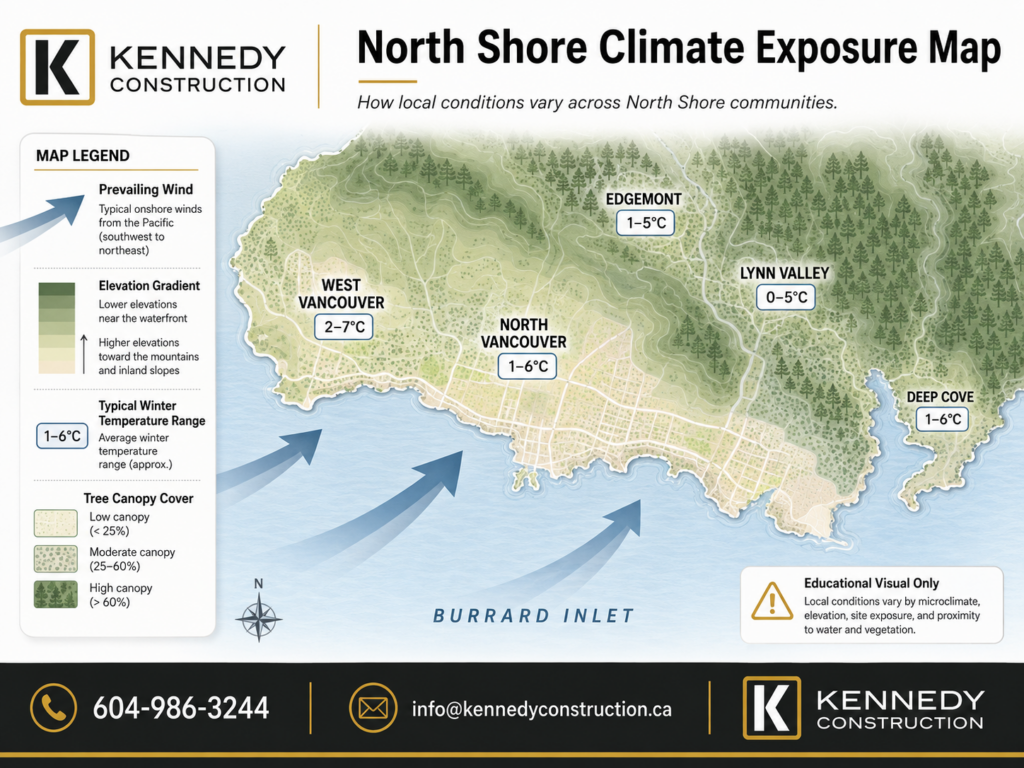
Metro Vancouver falls within BC Building Code Climate Zone 4, which has specific minimum energy performance requirements for fenestration. Custom homes built to a higher standard than the minimum code often specify triple-pane glazing as part of a broader high-performance envelope strategy, particularly when targeting Step Code levels above the base requirement.
Where Triple-Pane Windows Make the Most Sense in a Custom Home
Not every window in a custom home needs to be triple-pane to deliver a high-performance result. The decision comes down to exposure, orientation, and the overall design intent.
Triple-pane is most valuable in these situations:
- North-facing walls with minimal solar gain and high heat loss potential
- Exposed elevations on properties at higher elevation or with significant wind exposure
- Bedrooms where condensation on cold glass creates moisture and comfort problems
- Large glazing areas in open-plan living spaces where occupants sit or sleep near the glass
- Homes targeting Step Code 3 or above, or passive house design principles
- Properties adjacent to arterial roads or other consistent noise sources where acoustic performance matters
Double-pane with a high-performance low-emissivity (low-e) coating and argon fill remains an appropriate choice for south-facing glazing designed to capture passive solar heat in winter. In some designs, specifying triple-pane on south-facing walls can actually reduce desirable solar heat gain, which is something worth discussing with your builder and designer before locking in specifications.
How Do the Two Options Compare on Sound Reduction?
One underappreciated benefit of triple-pane windows is their acoustic performance. The additional glass layer and sealed cavity absorb more sound energy than a double-pane unit of equivalent frame quality.
| Sound Source | Double-Pane Performance | Triple-Pane Performance |
| Rain and wind | Good attenuation | Better attenuation |
| Traffic noise | Moderate reduction | Noticeable improvement |
| Neighbourhood activity | Adequate | Meaningfully quieter |
| Low-frequency sound (bass) | Limited | Slightly better, still limited |
For custom homes in areas like Lower Lonsdale or properties near transit corridors, the acoustic improvement that comes with triple-pane is often mentioned by homeowners as one of the most noticeable quality-of-life benefits, even in homes not specifically designed for noise reduction.
What Should You Expect When Discussing Windows During a Custom Home Build?
A well-run custom home process integrates window specification into the broader building envelope strategy, not as an afterthought. Here is how a professional builder typically approaches this decision:
- Review site orientation and shadow analysis. Which walls receive direct sun, which are shaded, and how does the topography affect wind and moisture exposure.
- Establish energy performance targets. Are you building to minimum code, targeting a specific Step Code level, or pursuing a particular comfort standard?
- Evaluate the wall assembly. Window performance should align with the insulation and airtightness values in your wall system. A high-performance window in an under-insulated wall delivers diminishing returns.
- Compare window-by-window, not home-by-home. Assign window types based on orientation and function rather than specifying one product throughout.
- Review long-term ownership goals. Homeowners planning to stay for 15 or more years see a different cost-benefit picture than those building with a shorter horizon.
- Finalize specifications with your designer and builder together. Window choices affect structural headers, rough opening sizes, and finishing details, so locking in specs early avoids costly changes during construction.
If you are planning a custom home build in the Vancouver area, window specification is one of many building envelope decisions that rewards early attention and a builder who can explain the trade-offs clearly.
Common Mistakes Homeowners Make When Choosing Windows for a Custom Home
- Choosing windows based on frame style alone. Aesthetics matter, but thermal and acoustic performance should drive the specification, with aesthetics resolved within that framework.
- Treating window selection as separate from insulation and airtightness. Windows are part of the building envelope system. A gap in one area limits the performance of every other component.
- Assuming all triple-pane windows perform equally. Spacer bar material, gas fill type, low-e coating position, and frame construction all affect real-world performance. Brand and pane count are not the full story.
- Upgrading to triple-pane without improving air sealing. Infiltration around the window frame is often a larger heat loss pathway than the glass itself. The installation matters as much as the product.
- Not considering the impact on passive solar design. Specifying triple-pane across all south-facing glazing can reduce winter solar gain in ways that increase, rather than decrease, heating demand.
- Delaying the specification decision too late in the design phase. Window sizes affect structural elements. Changing specifications after framing begins is expensive and sometimes structurally limiting.
Air leakage through and around window frames can account for a significant percentage of total building heat loss in residential construction, with some estimates placing infiltration losses comparable to or exceeding conductive heat loss through the glass itself. This is one reason why installation quality and air sealing are prioritized in high-performance building programs such as BC Energy Step Code compliance.
Window choice also connects to indoor air quality. Condensation that forms on poorly performing glazing can encourage mould growth on window frames and sills over time. Homeowners who want to understand more about how the building envelope affects signs of poor indoor air quality on the North Shore will find that moisture control at the envelope level is one of the most effective preventative measures available.
Triple-pane windows are more commonly specified in Scandinavian and northern European countries, where cold climate performance standards have long required glazing with U-factors below 0.15. Canadian adoption has increased alongside the BC Energy Step Code rollout, with triple-pane becoming standard specification in Step 3 and above construction in climate zones similar to the North Shore.
Frequently Asked Questions
Are triple-pane windows worth it in Canada?
For many Canadian climates, yes, particularly in regions with cold winters and sustained heating seasons. On the North Shore, where winters are damp and cool rather than severely cold, the case for triple-pane is strongest on north-facing and shaded exposures, on homes with large glazing areas, and in builds targeting higher Step Code performance levels. For moderate climates with good passive solar design, high-performance double-pane can also deliver strong results. The decision is best made in the context of your specific home design rather than as a blanket rule.
What are the downsides of triple-pane windows?
The main downsides are cost, weight, and reduced solar heat gain. Triple-pane units cost more per window, and the cost difference adds up significantly across a full home. The additional glass layer makes the units heavier, which can affect hardware, sash size, and operability in some configurations. The extra layer of glass also reduces solar heat gain coefficient (SHGC), which can be a disadvantage on south-facing walls designed to capture passive solar heat in winter. None of these are reasons to avoid triple-pane where it is the right fit, but they are worth understanding before specifying.
What type of window is best for energy efficiency?
Energy-efficient windows combine several factors: multiple panes, low-e coatings on the appropriate glass surfaces, an inert gas fill (argon or krypton) in each sealed cavity, warm-edge spacer bars, and a thermally broken frame. Triple-pane units with these features deliver the highest thermal resistance currently available in residential glazing. That said, no window achieves the insulation value of a well-insulated wall, so windows should be sized and positioned thoughtfully as part of the overall building envelope design.
Are triple-pane windows quiet?
Triple-pane windows do provide better sound attenuation than standard double-pane units, and the improvement is noticeable for mid-frequency sounds like traffic, voices, and rain. The degree of improvement depends on the glass thickness, the cavity depth, and whether any acoustic interlayers are included in the glass specification. For homes near busy roads or with significant ambient noise, triple-pane windows are a meaningful upgrade. For very low-frequency sounds, no standard residential glazing provides complete attenuation, and acoustic glass with laminated interlayers may be worth considering in those situations.
What is the lifespan of triple-pane windows?
A quality triple-pane window installed correctly can be expected to perform well for 20 to 30 years or more, with the sealed gas-filled cavities typically warranted against failure for 10 to 20 years depending on the manufacturer. Seal failure, which causes fogging or condensation between the panes, is the most common long-term issue with any insulating glass unit. Using reputable window manufacturers and ensuring proper installation, particularly at the perimeter air seal, reduces the risk of premature seal failure significantly. Frame material also affects longevity, with fibreglass and uPVC frames generally outperforming wood in wet climates like the North Shore.
Making the Right Window Decision for Your North Shore Custom Home
Triple-pane windows are not always the right answer, and double-pane windows are not always a compromise. The right choice depends on your home’s design, its orientation, the wall assembly it sits within, and your long-term goals for the property.
What matters most is that this decision gets made as part of a coordinated building envelope strategy, early in the design process, with a builder who understands how all the components work together. Homeowners planning major investments in a custom home or a significant renovation deserve clear answers about where performance upgrades deliver lasting value and where money is better spent elsewhere.
A.W. Kennedy Construction has spent over 20 years building and renovating homes across North Vancouver, West Vancouver, and the broader North Shore. The team brings hands-on experience across every stage of residential construction, and that background informs practical decisions like window specification, air sealing, and building envelope performance. With 8 HAVAN Awards and a Georgie Award recognizing the quality of that work, Kennedy Construction is positioned to help homeowners make informed choices that hold up over time.
If you are planning a custom home or a large-scale renovation on the North Shore and want to discuss how building envelope decisions like window selection fit into the overall project, reach out to the team at Kennedy Construction to start the conversation.