How to Plan a Wellness-Focused Home Renovation on the North Shore
A wellness-focused home renovation addresses how your home affects your health, comfort, and daily quality of life, not just how it looks. For North Shore homeowners, that typically means improving thermal performance, indoor air quality, natural light, and spatial flow as part of a single integrated project. Done well, these upgrades compound each other and create a home that performs measurably better for years. Done in pieces, or with the wrong contractor, the results fall short of what was promised.
Key Takeaways
- Wellness renovations go beyond aesthetics to target how your home performs for the people living in it, covering air quality, thermal comfort, noise, and natural light.
- The North Shore’s climate and older housing stock make building envelope upgrades, airtightness improvements, and modern HVAC systems especially high-impact choices.
- The strongest wellness outcomes come from planning these upgrades together as a cohesive scope, not tackling them one at a time across separate projects.
- Contractor experience with large-scale residential renovations matters significantly here because wellness renovations span structural, mechanical, and finish trades simultaneously.
- For homeowners planning to stay long-term, a well-executed wellness renovation typically delivers better value than purchasing a different home and inheriting its problems.
Things You Must Know
1. Wellness upgrades only work when they’re coordinated
A high-performance HVAC system won’t deliver its full benefit in a home with a leaky building envelope. Better insulation with no attention to ventilation can trap humidity and degrade air quality. Each element of a wellness renovation depends on the others, which is why the planning phase needs to treat them as a system rather than a checklist. A contractor who specializes in large-scale renovations will assess the home holistically before scoping the work.
2. Older North Shore homes carry specific risk factors
Much of the housing stock across North Vancouver and West Vancouver was built before current energy and airtightness standards. That means many homes have inadequate insulation, outdated heating systems, and building envelopes that allow significant air and moisture infiltration. Understanding what your specific home needs before finalizing a renovation scope is critical. Assumptions made early in planning often lead to surprises mid-project when the walls come open.
3. Cost objections deserve context, not dismissal
Wellness renovations cost more than standard cosmetic renovations because the materials and systems that genuinely improve how a home performs carry higher price points. A lower bid usually reflects a reduced scope, lower-quality materials, or less experienced trades. For homeowners planning to live in the home for the next 10 to 20 years, the long-term cost of under-investing in execution quality typically exceeds the upfront savings.
What Does “Wellness” Actually Mean in a Home Renovation Context?
The term gets used loosely, so it’s worth being specific. A wellness-focused renovation is one where the design and construction decisions are driven by how the home affects the people who live in it, physically and practically.
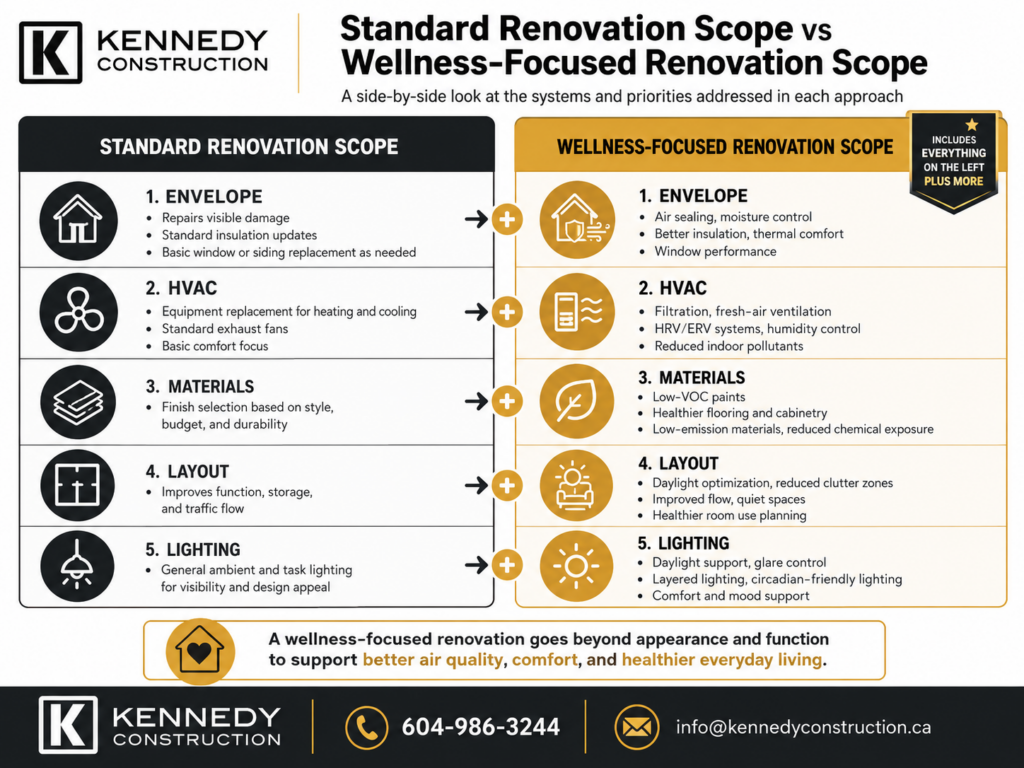
That includes thermal comfort (consistent temperatures, no cold floors or drafts), indoor air quality (proper ventilation, humidity control, low off-gassing from materials), natural light access, acoustic separation between rooms, and spatial flow that reduces friction in daily life. These are not luxury additions layered on top of a standard renovation. They’re a fundamentally different way of prioritizing what gets built.
Which Upgrades Have the Highest Wellness Impact on the North Shore?
Not all wellness upgrades carry equal weight. For homeowners on the North Shore, three categories consistently deliver the most meaningful improvements.
Thermal Comfort and Building Envelope Performance
The building envelope is the boundary between conditioned and unconditioned space: walls, roof, foundation, windows, and doors. In many older North Shore homes, this boundary is poorly insulated and riddled with air leakage. Cold spots, drafts, and uneven room temperatures are the visible symptoms. Heating bills and moisture problems are the less visible ones.
Improving the envelope through upgraded insulation, airtightness measures, and better windows creates a more stable interior environment year-round. It also reduces the load on your heating and cooling systems, which extends equipment life and lowers operating costs. Kennedy Construction’s whole-home envelope upgrades address this as a coordinated scope rather than isolated fixes.
Homes with significant air leakage can lose a substantial portion of their heating energy through the building envelope, with Ohio State University’s Green Home research finding that uncontrolled air infiltration is responsible for 25 to 40 percent of a home’s heating and cooling load.
Indoor Air Quality and Ventilation
Indoor air quality is one of the most overlooked factors in residential health and comfort. Modern homes are built tighter than older ones, which reduces energy waste but requires deliberate mechanical ventilation to maintain fresh air exchange. Older homes often have the opposite problem: uncontrolled air infiltration brings in outdoor pollutants and makes humidity management difficult.
A wellness renovation addresses both sides. Improving airtightness is paired with a properly designed ventilation system, typically a heat recovery ventilator (HRV) or energy recovery ventilator (ERV), that supplies filtered fresh air without wasting the energy used to condition it. The result is a home with better air quality and more predictable humidity levels through all seasons.
The EPA has noted that indoor air can be two to five times more polluted than outdoor air in some homes, with inadequate ventilation identified as a primary contributing factor — a finding documented in the EPA’s indoor air quality guidance across a wide range of residential settings regardless of location.
For homeowners concerned about how their home’s air quality may already be affecting their household, it’s useful to understand what the signs of poor indoor air quality actually look like before renovation planning begins.
Spatial Wellbeing: Light, Noise, and Flow
Layout decisions have a direct effect on how a home feels to live in. Rooms that receive little natural light, open-plan kitchens with no acoustic separation from bedrooms, or circulation paths that funnel traffic through the wrong spaces all erode daily comfort in ways that are hard to quantify but easy to feel.
A wellness renovation treats layout reconfiguration as a meaningful scope item rather than a cosmetic choice. Adding skylights, repositioning walls to open sight lines to outdoor views, or separating noisy and quiet zones of the home are changes that affect daily life more than most finish upgrades.
How to Sequence a Wellness Renovation: A Step-by-Step Planning Approach
- Start with a whole-home assessment. Before defining a scope, have an experienced contractor evaluate the existing building envelope, mechanical systems, and layout. This surfaces the highest-impact problems and prevents expensive surprises mid-construction.
- Define your wellness priorities. Decide which categories matter most to your household, whether that’s thermal comfort, air quality, noise, natural light, or a combination. This shapes how budget gets allocated across the project.
- Develop an integrated scope. Envelope, mechanical, and layout work need to be coordinated in a single plan. Changes to one system affect the others, so sequencing matters and scope gaps cause problems.
- Select materials intentionally. Low-VOC paints, formaldehyde-free insulation, and durable finishes all contribute to long-term indoor air quality. The best healthy building materials for the North Shore’s climate are worth discussing with your contractor early in the design phase.
- Confirm permits and compliance. Wellness renovations that involve structural work, HVAC replacement, or changes to the building envelope typically require permits through the District or City of North Vancouver. Your contractor should manage this process as part of the project.
- Plan for the construction phase. Major renovations displace households for weeks or months depending on scope. Clarify the timeline, phasing, and your contractor’s communication process before signing a contract.
Comparing Renovation Approaches: What You’re Actually Choosing Between
| Approach | What It Addresses | Typical Outcome |
| Cosmetic renovation only | Finishes, fixtures, aesthetics | Updated appearance; underlying performance issues remain |
| Phased wellness upgrades | One system at a time (e.g. HVAC only) | Partial improvement; interdependencies often missed; higher total cost over time |
| Integrated wellness renovation | Envelope, mechanical, layout, materials together | Measurable improvement in comfort, air quality, and energy performance; systems work together |
| Purchasing a different home | Location change | High transaction costs; likely inheriting similar performance problems in an older home |
Common Mistakes Homeowners Make When Planning a Wellness Renovation
- Treating wellness features as add-ons. Ventilation, airtightness, and thermal upgrades need to be built into the project from the start. Trying to incorporate them after the structural and mechanical scope is set usually results in compromises that reduce the outcome.
- Choosing a contractor based on price alone. A lower bid in this category almost always reflects reduced scope or lower-grade systems, both of which undermine the wellness goals the renovation was meant to achieve.
- Underestimating the role of moisture management. The North Shore’s climate brings significant rainfall and humidity. Moisture control in North Shore renovations is a technical discipline, not an afterthought, and contractors without specific experience in it can create long-term problems even with good intentions.
- Skipping the whole-home assessment. Starting with a predetermined scope before understanding what the home actually needs leads to budget allocation that misses the highest-impact opportunities.
- Separating the design and construction phases with different teams. Wellness renovations require tight coordination between the design vision and construction execution. Misalignment between a designer and a contractor on technical specifications creates gaps that show up as performance shortfalls after move-in.
What Does a Wellness Renovation Cost on the North Shore?
| Scope Category | Example Work | Cost Notes |
| Building envelope | Insulation, airtightness, window upgrades | Varies significantly by home size, existing condition, and extent of work |
| Mechanical systems | HVAC replacement, HRV/ERV installation | Depends on home size, existing ductwork, and system type selected |
| Layout reconfiguration | Structural changes, wall removal, addition of skylights | Structural complexity and permit requirements affect cost materially |
| Full integrated renovation | All of the above as a coordinated whole-home project | Large-scale wellness renovations on the North Shore typically start at $300,000 and scale with scope |
Renovation costs on the North Shore tend to run higher than Metro Vancouver averages due to local labour market conditions, site access considerations, and the higher baseline cost of quality materials in the region — a pattern confirmed by a 2026 North Vancouver renovation cost guide that places local pricing 10 to 20 percent above Metro Vancouver averages, driven by mountainous terrain, older housing stock, and high contractor demand.
Frequently Asked Questions
What does a wellness-focused home renovation actually include?
A wellness-focused renovation goes beyond aesthetics to address how your home affects your daily health and comfort. Common elements include improving indoor air quality through better ventilation and airtightness, upgrading insulation and the building envelope to eliminate drafts and cold spots, installing modern HVAC systems for consistent temperature and humidity control, and reconfiguring layouts to bring in more natural light and reduce noise. For North Shore homeowners investing in a long-term home, these upgrades create measurable improvements in how the home feels to live in every day.
Is a wellness renovation worth the investment, or is it better to move?
For homeowners on the North Shore committed to their neighbourhood and property, a comprehensive wellness renovation is often the stronger long-term decision. Purchasing a new home carries significant transaction costs, land transfer taxes, and the likelihood of inheriting similar performance problems in another older home. A well-executed renovation addresses the specific deficiencies of your existing home while tailoring the result to how your family actually lives. The key is working with an experienced contractor who can assess the full scope and deliver it as an integrated project rather than a series of disconnected fixes.
How do I know if my contractor has the experience to handle both the structural and wellness elements of a large renovation?
Wellness renovations require work across multiple disciplines simultaneously, so your contractor’s breadth of experience matters as much as technical skill in any single area. Look for contractors with a long track record in large-scale residential renovations specifically, not just smaller remodels, and ask to see past projects of comparable scope. Industry recognition such as HAVAN Awards or Georgie Awards signals that a contractor’s work has been independently evaluated against high standards. A.W. Kennedy Construction has earned 8 HAVAN Awards and 1 Georgie Award over more than 20 years specializing in major residential renovations on the North Shore.
What are the most impactful wellness upgrades to prioritize?
The highest-impact improvements typically fall into three categories: thermal comfort and energy performance (building envelope upgrades, improved insulation, airtightness), air quality and ventilation (modern HVAC with proper air exchange and filtration), and spatial wellbeing (layout changes that improve natural light, reduce noise transfer, and create flow suited to your household). These upgrades compound each other. A more airtight envelope works in concert with a properly sized HVAC system, which is why they’re best planned and executed together rather than addressed separately over time.
Why does a wellness-focused renovation cost more, and is the investment justified?
Wellness renovations carry higher upfront costs because the materials, systems, and labour required to genuinely improve how a home performs cost more than standard-grade alternatives. A lower bid usually reflects shortcuts in one or more of these areas, which means the promised wellness benefits won’t fully materialize. For North Shore homeowners planning to stay in their home long-term, the investment is justified through improved comfort and health, reduced energy costs, fewer maintenance issues, and a home that performs better for years to come. The real risk at this scale is under-investing in execution quality and ending up with a renovation that doesn’t deliver what was promised.
Planning Your Wellness Renovation on the North Shore
A wellness-focused home renovation is one of the most meaningful investments a North Shore homeowner can make in their property and their household’s long-term quality of life. The outcomes are real and lasting when the project is scoped correctly, executed by a contractor with the right experience, and treated as a coordinated whole rather than a collection of individual upgrades.
A.W. Kennedy Construction has been delivering large-scale residential renovations on the North Shore for over 20 years. The team holds 8 HAVAN Awards and 1 Georgie Award, and brings the kind of integrated expertise that wellness renovations require across structural, mechanical, and finish work. If you’re planning a significant renovation and want to understand what a wellness-focused scope would look like for your home, reach out to the Kennedy Construction team directly.
Call Kennedy Construction at 604-986-3244 to discuss your project and get an honest assessment of what your home needs.
