What Are Signs of Poor Indoor Air Quality in North Shore Homes?
Poor indoor air quality shows up through persistent symptoms like headaches, chronic congestion, and musty odours, along with visible signs like condensation, mould growth, and excessive dust accumulation. In older North Shore homes especially, inadequate ventilation, aging insulation, and moisture intrusion are common root causes. Addressing these issues through targeted renovations can meaningfully improve both air quality and long-term home comfort.
North Shore homes have character. Many were built in an era when “airtight construction” wasn’t a design priority, and decades of coastal moisture, temperature swings, and deferred maintenance have taken a toll on building envelopes. If your home feels stuffy, smells off, or your family keeps getting headaches they can’t explain, the air inside your home may be the problem.
Key Takeaways
- Poor indoor air quality often goes undetected for years because symptoms mimic everyday ailments like allergies or seasonal colds.
- Visible signs such as condensation on windows, mould patches, and persistent dust are warning indicators that shouldn’t be dismissed.
- Older homes on the North Shore are particularly vulnerable due to inadequate vapour barriers, aging insulation, and limited mechanical ventilation.
- Health symptoms including chronic headaches, fatigue, and respiratory irritation that improve when you leave the home are a strong signal to investigate air quality.
- A professional air quality test combined with a building envelope assessment is the most reliable way to identify and solve the root cause.
- Many air quality problems are directly correctable through strategic renovations, including insulation upgrades, ventilation improvements, and envelope sealing.
Things You Must Know
1. Symptoms Alone Won’t Tell You the Cause
Headaches, fatigue, and nasal irritation are real signals, but they point toward a problem rather than a specific source. Mould, volatile organic compounds (VOCs) from building materials, inadequate fresh air exchange, and high humidity can all produce overlapping symptoms. A proper air quality assessment paired with a building inspection is what actually identifies what’s happening, so avoid guessing and treating surface symptoms when the root cause may be structural.
2. North Shore Climate Makes Moisture Management Especially Critical
The North Shore receives significantly more rainfall than most Metro Vancouver areas, and homes in Lynn Valley, Deep Cove, and Upper Lonsdale frequently deal with ground moisture, condensation, and below-grade dampness. Moisture that infiltrates a building envelope doesn’t just damage structure; it creates the conditions mould needs to grow and degrades air quality over time. Understanding why moisture control matters in North Shore home renovations is foundational to solving many chronic air quality problems.
3. Renovating to Improve Air Quality Is a Long-Term Investment, Not a Quick Fix
Replacing a filter or opening windows addresses symptoms temporarily. The underlying causes, whether that’s a compromised vapour barrier, insufficient bathroom exhaust capacity, or spray foam failing at rim joists, require proper construction work to resolve. Homeowners planning significant renovations are actually in the best position to correct air quality issues at the same time, since walls, ceilings, and mechanical systems are already being touched.
What Are the Most Common Signs of Poor Indoor Air Quality?
The signs of poor indoor air quality fall into two categories: physical symptoms experienced by the people living in the home, and observable conditions within the home itself. Both matter, and both often show up together.
Physical and Health-Related Signs
If you or family members regularly experience any of the following, and those symptoms improve noticeably when you spend time away from home, that pattern is worth taking seriously.
- Persistent headaches, especially in the morning or after waking
- Chronic nasal congestion, sneezing, or runny nose without a confirmed allergy source
- Eye, throat, or skin irritation that has no other explanation
- Unusual fatigue or difficulty concentrating while at home
- Worsening asthma or respiratory conditions
- Coughing or phlegm production that lingers without illness
- Dizziness or lightheadedness in specific rooms
The “away from home” test is one of the most telling indicators. When symptoms clear up on vacation or after a few nights elsewhere, the home environment is a likely contributor.
Observable Signs Inside the Home
Beyond how people feel, the home itself will often show signs of an air quality problem if you know where to look.
- Musty or stale odours that don’t respond to cleaning or ventilation
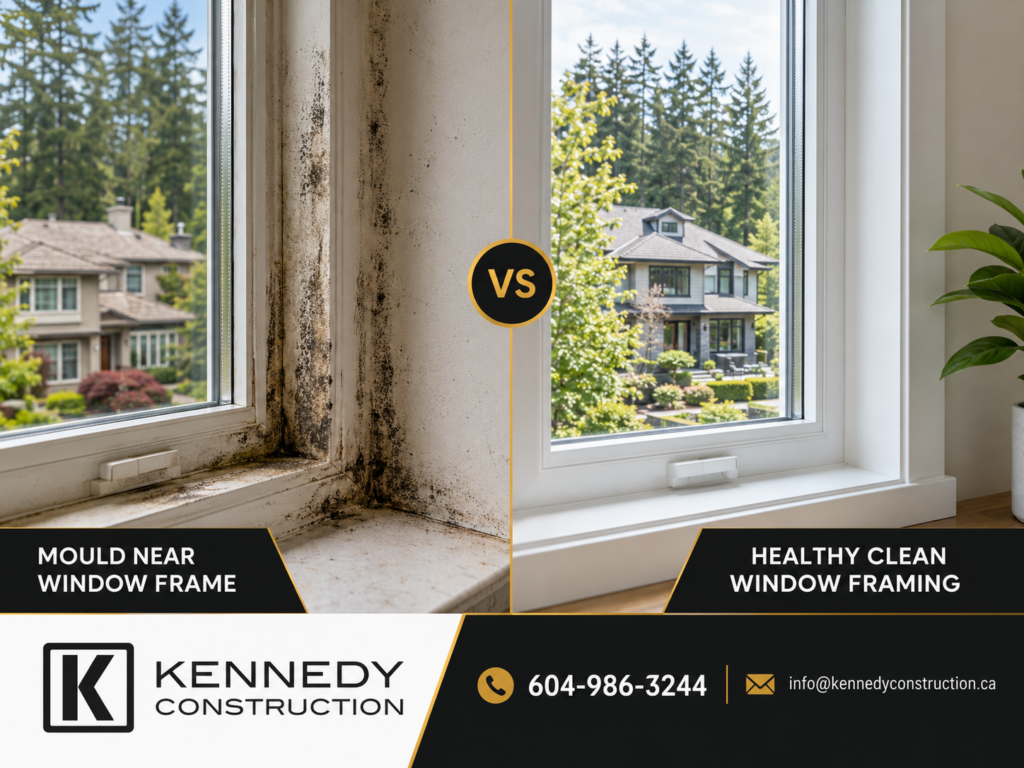
- Visible mould or mildew, particularly in bathrooms, crawl spaces, or around windows
- Excessive condensation on windows, especially in winter
- Dust that accumulates rapidly despite regular cleaning
- Visible moisture staining on walls or ceilings
- Peeling paint or warped trim in areas prone to humidity
- An unusually humid or clammy feel in finished rooms
What Causes Poor Air Quality in Older North Shore Homes?
Understanding the symptom is only part of the picture. The causes matter more, because the right fix depends entirely on what’s driving the problem.
Indoor air can be two to five times more polluted than outdoor air, according to environmental health research, partly because modern homes trap airborne contaminants that older mechanical systems were never designed to address at today’s concentration levels.
Inadequate Ventilation
Many homes built before the 1990s were not designed with controlled mechanical ventilation. They relied on natural air leakage through gaps in the building envelope to bring in fresh air. As homes have been tightened up over the years through window replacements and insulation upgrades, that passive air exchange has been reduced without an equivalent mechanical system put in its place. The result is stale, recirculated indoor air.
Moisture Intrusion and Mould
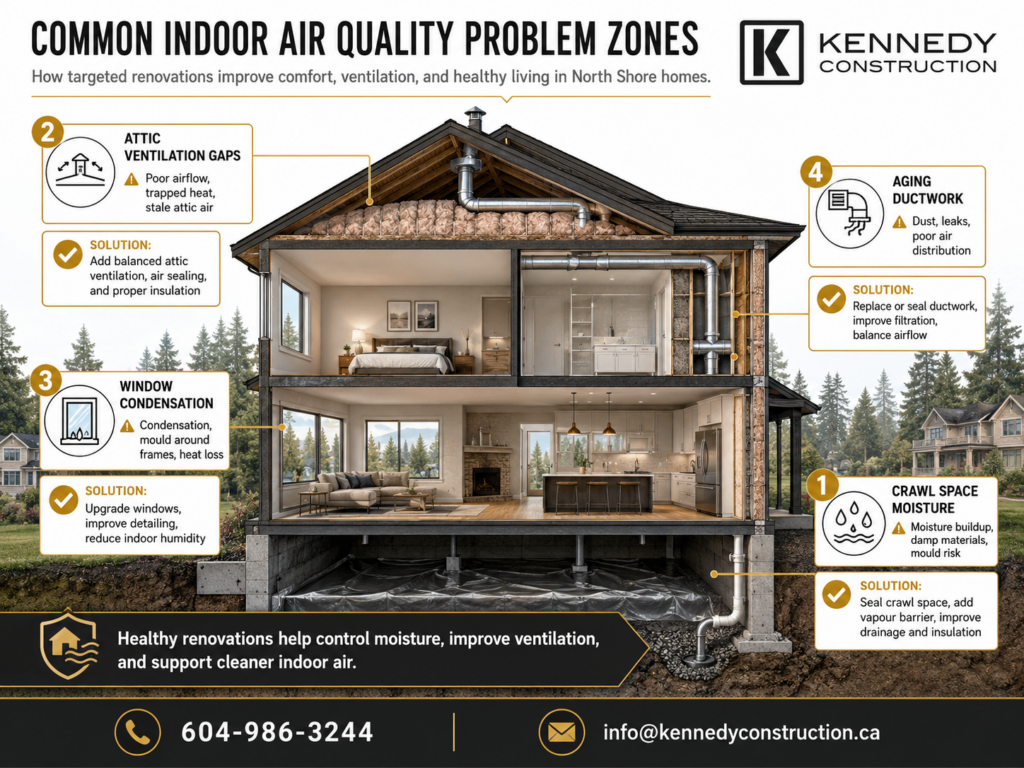
Coastal climates amplify every moisture-related risk. Crawl spaces without proper vapour barriers, bathrooms with undersized exhaust fans, and building envelopes with compromised flashing are all common sources of ongoing moisture introduction. Once moisture gets into wall cavities or subfloor assemblies, mould growth follows, and its spores circulate through the living space continuously.
Aging or Deteriorating Building Materials
Homes built before the late 1980s may contain building materials that off-gas VOCs, including certain adhesives, finishes, and insulation products that were phased out or reformulated in subsequent decades. As these materials age and degrade, the rate and nature of off-gassing can change in ways that affect occupant health.
HVAC Systems and Ductwork
Forced-air heating systems that haven’t been serviced, have deteriorating ductwork, or are pulling air from unconditioned spaces like crawl spaces or attics can actively distribute contaminants throughout the home. Dust, mould spores, and rodent debris in neglected duct systems are not uncommon in homes that are 30 or more years old.
How Do Different Air Quality Issues Compare?
| Issue Type | Common Source | Key Warning Sign | Renovation Solution |
| Mould and mildew | Moisture intrusion, condensation | Musty odour, visible spots | Envelope sealing, vapour barrier, ventilation |
| VOC off-gassing | Aging finishes, adhesives, materials | Chemical smell, headaches | Low-VOC material replacement, HRV installation |
| Stale/recirculated air | Poor mechanical ventilation | Stuffy feeling, fatigue | HRV/ERV system installation |
| Dust and particulates | Aging ductwork, poor filtration | Rapid dust build-up, sneezing | Duct sealing, upgraded filtration, HVAC replacement |
| High humidity | Crawl space moisture, inadequate exhaust | Condensation, clammy air | Crawl space encapsulation, exhaust fan upgrades |
—
How Does a Home Renovation Address Indoor Air Quality Problems?
A well-planned renovation isn’t just about aesthetics or added square footage. For many North Shore homeowners, it’s also the most practical opportunity to correct the structural and mechanical conditions driving poor air quality. Choosing healthy building materials for home renovation on the North Shore is one piece of a larger picture that includes envelope performance and ventilation design.
- Assess the building envelope first. Before any work begins, understanding where moisture is entering and where air is escaping is essential. This often involves a blower door test, moisture readings, and a visual inspection of attic, crawl space, and rim joist conditions.
- Correct moisture pathways. This may include replacing or installing vapour barriers, improving drainage around the foundation, re-flashing roof penetrations, or re-sealing the building envelope at critical junctions.
- Upgrade insulation with airtightness in mind. Properly installed insulation reduces thermal bridging, limits condensation risk within wall assemblies, and supports a more controlled interior environment.
- Install or upgrade mechanical ventilation. A heat recovery ventilator (HRV) or energy recovery ventilator (ERV) brings in controlled fresh air while recovering heating energy, solving the ventilation problem without increasing energy costs significantly.
- Upgrade or replace aging HVAC systems. Modern systems with better filtration, sealed duct design, and appropriate sizing for the home’s current air volume perform far better than equipment installed decades ago.
- Select low-VOC finishes and materials. During any renovation, specifying low-emission paints, adhesives, flooring underlayments, and cabinetry materials reduces ongoing chemical off-gassing in the finished space.
A home renovation to improve indoor air quality works best when these elements are addressed together rather than in isolation, since they interact with one another in the building system as a whole.
Common Mistakes Homeowners Make When Dealing With Air Quality Issues
- Treating mold without finding the moisture source. Cleaning or painting over mould without correcting the underlying moisture condition guarantees it will return, often worse. The mold is a symptom, not the root problem.
- Relying on air purifiers as a permanent solution. Portable air purifiers can reduce particulates in a room, but they don’t correct inadequate ventilation, moisture intrusion, or off-gassing from building materials.
- Tightening the envelope without adding ventilation. Adding insulation or new windows without a corresponding mechanical ventilation upgrade can actually worsen air quality by reducing the passive air exchange the home previously relied on.
- Ignoring crawl spaces and attics. These areas are out of sight and often out of mind, but they are among the most common sources of moisture, mould, and particulate introduction into living spaces on the North Shore.
- Assuming new construction doesn’t have air quality risks. New builds use materials that off-gas during their first months, and construction-phase moisture management matters as much as long-term performance. Proper specification and sequencing during construction is the preventive approach.
What Does an Air Quality Problem Cost to Correct?
The cost to address indoor air quality problems through renovation varies significantly depending on scope. A targeted moisture remediation and vapour barrier upgrade in a crawl space will differ substantially in cost from a whole-home envelope improvement combined with a new HVAC and ventilation system. In general terms, air quality improvements that are incorporated into a larger renovation project carry better cost efficiency than standalone remediation work, since trades and access costs are shared across the broader scope.
| Scope of Work | Complexity Level | Best Timing |
| Crawl space vapour barrier and encapsulation | Moderate | Standalone or during foundation work |
| HRV/ERV mechanical ventilation installation | Moderate to High | During HVAC upgrade or renovation |
| Insulation and airtightness upgrade | Moderate to High | During wall or attic access renovation |
| Full envelope remediation and HVAC replacement | High | Whole-home or major renovation project |
Homeowners who incorporate air quality improvements into a broader renovation often see compounding benefits, including lower heating and cooling costs from improved airtightness, reduced maintenance costs from better moisture control, and improved long-term property value from verified healthy building performance.
Frequently Asked Questions
How do you know if you have poor indoor air quality?
The most telling indicator is a pattern: symptoms like headaches, fatigue, nasal irritation, or throat discomfort that appear at home and ease when you’re away. Observable signs, including musty odours, condensation on windows, visible mould, and excessive dust, also point toward an air quality issue. If you’re seeing both physical symptoms and physical signs in the home, that combination warrants a professional assessment rather than further waiting.
Can poor air quality cause heart palpitations?
In some cases, yes. Exposure to elevated levels of carbon monoxide, particulate matter, or certain VOCs has been associated with cardiovascular effects including elevated heart rate and palpitations in sensitive individuals. This is more likely to occur with significant pollutant concentrations over time. If you’re experiencing heart palpitations in your home environment and cannot identify another cause, it’s worth having both a medical evaluation and a home air quality test, including carbon monoxide levels, conducted promptly.
Can bad air quality cause phlegm?
Yes. Chronic exposure to indoor air pollutants, particularly mould spores, dust mites, VOCs, and fine particulates, can irritate the respiratory tract and trigger excess mucus production. This often presents as a persistent cough, post-nasal drip, or the feeling of phlegm that doesn’t clear up the way a standard cold would. If respiratory symptoms persist beyond typical illness timelines and don’t respond to treatment, the indoor environment is worth investigating.
How do you know if the air in your house is toxic?
The word “toxic” is relative to concentration and exposure duration, but serious air quality concerns include elevated carbon monoxide (detectable by CO monitors, which every home should have), high radon levels (tested with passive or active radon test kits), significant mould growth in wall cavities or HVAC systems, and VOC off-gassing above established thresholds. You can learn more about how to test indoor air quality in your North Shore home through professional assessment methods. A combination of home monitors, professional testing, and a building inspection provides the most complete picture.
How do I test the air quality inside my house?
Testing options range from consumer-grade air quality monitors (which measure particulates, VOCs, CO2, and humidity in real time) to professional laboratory testing for specific contaminants like radon, mould spores, asbestos fibres, or chemical compounds. For homeowners in older North Shore homes with specific concerns, a professional inspection that combines building envelope assessment with targeted air sampling will give you actionable findings rather than general readings. Consumer monitors are useful for ongoing awareness; professional testing is what you need when you’re trying to make renovation or remediation decisions.
—
If Your Home Has These Signs, It’s Worth Addressing Properly
Poor indoor air quality is rarely dramatic in its early stages. It tends to show up quietly, through symptoms that get attributed to allergies, stress, or seasonal illness. The homes most affected on the North Shore are often the ones that have the most character: older builds with histories of renovation, deferred maintenance, or changing occupancy patterns that altered how the home breathes.
What separates a real fix from a temporary patch is understanding what the home is doing structurally, and addressing the causes rather than the symptoms. That work, done properly during a renovation, produces a home that performs better in every dimension: healthier air, more consistent comfort, and lower operating costs over the years ahead.
A.W. Kennedy Construction has been working on North Shore homes for over 20 years, with a team that understands the specific performance demands of residential construction in this climate. If you’re planning a significant renovation and want to address air quality as part of the project scope, the conversation is worth having early, before decisions are made that close off the best options.
To discuss your project, contact Kennedy Construction at 604-986-3244.