Can Bad Indoor Air Quality Make You Sick in North Shore Homes?
Yes, poor indoor air quality can make you sick. Symptoms range from headaches and fatigue to chronic respiratory issues, depending on the pollutants involved and the duration of exposure. In North Shore homes, which often deal with moisture, aging building envelopes, and limited ventilation, indoor air problems are more common than many homeowners realize and are frequently addressed through targeted renovations.
Most people assume the air inside their home is safe. After all, you’re not standing next to traffic or breathing industrial exhaust. But the reality is that indoor air can be significantly more polluted than outdoor air, and for families spending the majority of their time indoors, that matters. If someone in your household keeps getting headaches, wakes up congested, or feels inexplicably tired at home but fine elsewhere, the air quality deserves a closer look.
Key Takeaways
- Poor indoor air quality is a documented health risk, with symptoms ranging from irritation and fatigue to serious respiratory conditions over time.
- North Shore homes face specific air quality risks related to coastal humidity, older construction methods, and insufficient ventilation in tightly sealed renovations.
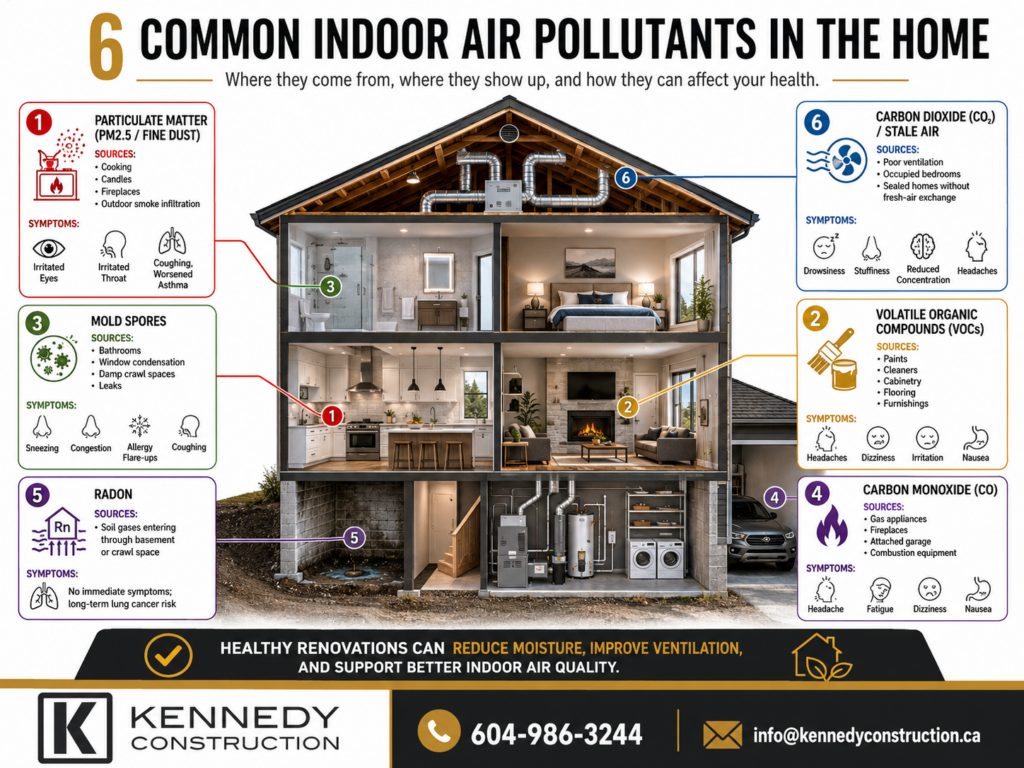
- Common indoor pollutants include mold spores, VOCs from building materials, dust mite allergens, combustion byproducts, and radon.
- Health effects depend on the type of pollutant, the concentration, and how long exposure has been ongoing.
- Many air quality problems in older homes are resolved during major renovations by improving ventilation, replacing materials, and upgrading the building envelope.
- Testing is the most reliable way to confirm whether indoor air is contributing to health symptoms at home.
Things You Must Know
1. Symptoms Alone Don’t Confirm an Air Quality Problem
Fatigue, congestion, headaches, and eye irritation can have many causes. Before attributing symptoms to indoor air, it helps to notice whether they improve when you leave the home for an extended period. If symptoms ease when you’re away for a week and return when you’re back, that’s a meaningful pattern worth investigating. A professional air quality assessment is the most reliable next step, not guesswork.
2. Renovation Work Can Temporarily Worsen Air Quality
Older homes being renovated often release pollutants that were previously contained, including dust, mold spores, and in some cases asbestos or lead paint from materials installed decades ago. Reputable contractors manage this with proper containment, sequencing, and ventilation during construction. If you’re planning a major renovation in a home built before 1990, this is a conversation worth having with your contractor before work begins.
3. Airtight Homes Need Controlled Ventilation
One of the most common oversights in modern renovations is sealing a home for energy efficiency without installing an adequate mechanical ventilation system. A tighter building envelope reduces drafts and heat loss, but it also traps stale air and moisture indoors. High-performance renovations pair airtightness improvements with systems like heat recovery ventilators (HRVs) to maintain fresh air exchange without sacrificing efficiency.

What Does Poor Indoor Air Quality Actually Do to the Body?
The health effects of indoor air pollution fall into two broad categories: short-term and long-term. Short-term effects are often dismissed because they resemble everyday ailments. Long-term effects are more serious and develop gradually, which makes them harder to connect to the home environment.
Short-Term Symptoms
- Headaches and dizziness
- Eye, nose, and throat irritation
- Fatigue and difficulty concentrating
- Sneezing and congestion that doesn’t follow typical allergy seasons
- Nausea in more acute cases (often associated with carbon monoxide or chemical fumes)
Long-Term Health Risks
- Chronic respiratory conditions, including worsened asthma and bronchitis
- Lung damage from prolonged exposure to particulates or VOCs
- Increased sensitivity to allergens
- Cardiovascular effects linked to prolonged fine particulate exposure
- In cases involving radon exposure, elevated lung cancer risk over years or decades
The US Environmental Protection Agency has stated that indoor air can be two to five times more polluted than outdoor air, and in some cases significantly more, depending on the pollutant sources present and how much fresh air exchange occurs in the space.
What Are the Most Common Causes of Poor Indoor Air Quality?
Understanding where pollutants come from is the first step toward addressing them. In North Shore homes, several sources appear repeatedly, particularly in older construction or in homes that have undergone partial renovations over the years.
Mold and Moisture
Moisture is the single most common driver of poor air quality in homes on the North Shore. The combination of coastal humidity, heavy rainfall, and older building envelopes creates conditions where mold can establish itself inside wall cavities, below subfloors, and around windows and roof penetrations. Mold spores circulate through the air and are linked to respiratory irritation, allergic reactions, and more serious health effects in people with compromised immune systems.
If you want to understand how moisture works its way into a structure and what it takes to address it properly, the connection between moisture control and North Shore home renovations explains why this issue deserves attention well before symptoms appear.
Volatile Organic Compounds (VOCs)
VOCs are emitted as gases from a wide range of solid materials and liquids, including paints, varnishes, adhesives, flooring, cabinetry, and cleaning products. Concentrations of VOCs tend to be highest in newly renovated or furnished spaces and can remain elevated for months in poorly ventilated rooms.
Combustion Byproducts
Gas appliances, wood-burning fireplaces, and attached garages are common sources of carbon monoxide and nitrogen dioxide in residential spaces. These gases are odorless and colorless, which makes them particularly dangerous. Homes with older or poorly maintained combustion appliances carry a higher risk, especially if those spaces lack proper ventilation or carbon monoxide detection.
Particulate Matter and Dust
Older homes accumulate dust that contains allergens from dust mites, pet dander, and degraded insulation materials. Forced-air heating systems without proper filtration can distribute these particulates throughout the home every time the heat runs. In homes with original ductwork from the 1970s or 1980s, accumulated contamination inside the ducts can be a persistent source of airborne particles.
Radon
Radon is a naturally occurring radioactive gas that enters homes through foundation cracks and gaps in the building envelope. It is the second leading cause of lung cancer in Canada after smoking. Radon levels vary significantly by location and soil type, and testing is the only way to know whether levels in a specific home are within a safe range.
Indoor Air Quality Problem Sources at a Glance
| Pollutant | Common Sources | Typical Symptoms | Detectable By |
| Mold Spores | Moisture intrusion, leaks, poor ventilation | Congestion, coughing, skin irritation | Air sampling, visual inspection |
| VOCs | Paints, adhesives, new flooring, cabinetry | Headaches, dizziness, eye irritation | VOC meters, professional testing |
| Carbon Monoxide | Gas appliances, attached garages, fireplaces | Headaches, nausea, confusion | CO detector (mandatory in BC) |
| Radon | Soil and foundation entry points | No short-term symptoms; long-term cancer risk | Long-term radon test kits |
| Particulate Matter | Dust, pet dander, old ductwork, insulation | Sneezing, asthma flares, throat irritation | Particle counters, air quality monitors |
How Do You Know If Your Home Is the Problem?
The clearest signal is a pattern. If symptoms consistently improve when household members spend extended time outside the home and reliably return after a day or two back inside, the home environment is worth investigating. This pattern is distinct from a cold or flu, which follows its own timeline regardless of location.
Other signs that the home itself may be contributing to health issues include persistent musty odors in specific rooms, condensation forming regularly on interior windows, visible discoloration near vents or in corners, and allergy-like symptoms that don’t respond to standard treatments or are present year-round rather than seasonally.
If you’re looking for a structured way to evaluate what’s happening, understanding the signs of poor indoor air quality in North Shore homes can help you decide whether professional testing is the right next step.
How to Test Indoor Air Quality in Your Home
Testing options range from consumer-grade monitors to professional assessments. Each has a different purpose and level of reliability.
- Purchase a consumer air quality monitor. These devices measure particulates, VOCs, CO2, humidity, and sometimes radon. They provide useful ongoing data but are not a substitute for laboratory-grade testing when health concerns are serious.
- Use a long-term radon test kit. These kits are inexpensive, widely available, and the recommended method for screening radon levels over a 90-day period. They provide far more accurate results than short-term kits.
- Request a professional mold inspection. If moisture damage is suspected, a professional inspection can identify hidden mold in wall cavities and other inaccessible areas that a visual check would miss.
- Have combustion appliances serviced. A licensed HVAC technician can assess gas appliances for proper operation and identify any combustion spillage that could be introducing carbon monoxide into living spaces.
- Commission a comprehensive indoor air quality assessment. For homes with unexplained symptoms and no obvious source, a professional assessment tests for multiple pollutant categories simultaneously and provides a report you can act on.
If you’re not sure where to start, a guide on how to test indoor air quality in your North Shore home covers the testing options in more detail and helps homeowners decide which approach fits their situation.
Can a Renovation Fix Indoor Air Quality Problems?
In many cases, yes. A well-planned renovation is one of the most effective ways to address the root causes of poor indoor air quality rather than just managing symptoms. Replacing degraded insulation, sealing the building envelope, upgrading ventilation, and choosing low-emission materials can fundamentally change the air environment inside a home.
| Renovation Type | Air Quality Benefit |
| Building envelope upgrade | Prevents moisture infiltration and reduces mold risk |
| HRV/ERV installation | Provides continuous fresh air exchange without heat loss |
| Low-VOC materials selection | Reduces off-gassing from new finishes and cabinetry |
| HVAC upgrade with proper filtration | Removes airborne particulates more effectively |
| Radon sub-slab depressurization | Redirects radon away from living spaces before it enters |
For homeowners in North Shore who are already planning a significant renovation, it’s worth understanding how a home renovation can improve indoor air quality and overall wellness as part of the broader project scope, rather than treating air quality as a separate problem to solve later.
Common Mistakes Homeowners Make With Indoor Air Quality
- Relying on air fresheners or purifiers as a solution. These can mask odors or filter some particulates, but they don’t address the source. A mold problem behind drywall won’t be fixed by a HEPA filter running in the living room.
- Sealing a home without adding mechanical ventilation. This is one of the most consequential oversights in home renovation. Airtightness without ventilation traps moisture and stale air, often creating worse conditions than the drafty original structure.
- Assuming new construction means clean air. Newly renovated or built spaces often have the highest VOC concentrations due to fresh paints, adhesives, and synthetic materials. Ventilating aggressively for the first several months matters.
- Skipping radon testing because symptoms aren’t present. Radon exposure produces no immediate symptoms. By the time it becomes a health issue, years of accumulation have already occurred. Testing is straightforward and inexpensive relative to the risk.
- Treating air quality concerns as a minor issue in renovation planning. Homeowners investing $300,000 or more in a whole-home renovation should factor ventilation, moisture control, and material selection into the design phase, not as afterthoughts.
Frequently Asked Questions
How long can you get sick from bad air quality?
It depends on the pollutant and the level of exposure. Short-term symptoms from VOCs or carbon monoxide may resolve within hours of getting fresh air. Ongoing exposure to mold, allergens, or particulates can produce persistent symptoms for as long as the source remains in the home. In cases where mold or a combustion issue has been present for years, some individuals experience sensitivities that take longer to resolve even after the source is removed. The key factor is addressing the source, not just the symptoms.
How do you tell if the air in your house is making you sick?
The most reliable indicator is a consistent pattern: symptoms improve significantly when you leave the home for several days and return when you’re back inside. Pay attention to whether multiple household members experience similar issues, whether symptoms worsen in specific rooms, and whether they align with seasons when windows are closed and ventilation is reduced. A professional air quality test or mold inspection can confirm whether a specific pollutant is present at problematic levels.
How can I tell if my house is making my family sick?
Watch for patterns across household members rather than isolated cases. If children and adults alike are experiencing unexplained fatigue, persistent congestion, frequent headaches, or irritated eyes specifically at home, the building environment deserves investigation. A musty smell, visible moisture damage, or a home that was recently renovated with conventional materials are additional factors that increase the likelihood of an air quality issue. Having the home tested rather than guessing is the most efficient path forward.
How do you test for toxic air in a home?
Several testing approaches exist depending on what you’re looking for. Long-term radon kits are the standard for radon screening. Professional mold testing involves air sampling and sometimes swab tests in areas of visible growth or suspected moisture damage. Consumer air quality monitors track VOCs, particulates, and CO2 on an ongoing basis. For a comprehensive picture, a professional indoor air quality assessment covers multiple pollutant categories simultaneously and provides actionable results. The right starting point depends on what symptoms or visible signs are present.
How do you remove toxins from air in a home?
The most effective approach is source removal rather than air treatment. This means fixing moisture problems that feed mold, replacing materials that off-gas VOCs, servicing combustion appliances, and sealing radon entry points. Mechanical ventilation systems like HRVs bring in fresh outdoor air while exhausting stale indoor air, which dilutes pollutant concentrations continuously. HEPA filtration helps with particulates and some allergens. For homes undergoing renovation, choosing low-emission materials and ensuring proper ventilation during and after construction significantly reduces post-renovation off-gassing.
Healthy Homes Start With Honest Construction
Poor indoor air quality is a real health risk, and for families living in older North Shore homes, it’s often more present than they realize. The good news is that a major renovation done right doesn’t just improve how a home looks or functions. It can fundamentally change the air environment your family lives in every day.
Choosing materials that emit less, designing for proper ventilation from the start, and managing moisture at the building envelope level are decisions made during the construction process. They’re difficult to retrofit later without significant cost. If you’re planning a large-scale renovation and want to ensure the result is a healthier home, not just a better-looking one, Kennedy Construction has been helping North Shore homeowners think through exactly these questions for over 20 years.
To talk about a renovation that addresses both the aesthetics and the fundamentals of your home, contact Kennedy Construction at 604-986-3244.