In North Vancouver, most home renovation permits take 4 to 12 weeks to process depending on project scope, but complex structural or secondary suite applications can stretch beyond 3 months. Permit fees are calculated as a percentage of construction value, typically ranging from $500 to $3,500 or more for residential renovations. Understanding what triggers a permit requirement, what reviewers look for, and where applications stall can save homeowners significant time and money.
You’ve got a renovation planned. Maybe it’s a kitchen overhaul, a basement suite, or a structural wall removal to open up your main floor. The contractor is ready. Materials are priced. Then someone mentions permits, and suddenly the whole schedule feels uncertain. That uncertainty is the problem this guide addresses directly, with specific timelines, real cost breakdowns, and an honest look at what sends permit applications sideways in North Vancouver.
Key Takeaways
- Most residential renovation permits in North Vancouver take 4 to 8 weeks for straightforward projects; secondary suites and structural changes typically take longer.
- Permit fees are tied to declared construction value, not a flat rate, so larger projects cost proportionally more to permit.
- Incomplete drawings and missing site information are the most common reasons applications get sent back, adding weeks to your timeline.
- Working without a permit creates serious liability, including stop-work orders, forced demolition of completed work, and complications when selling your home.
- The City of North Vancouver and the District of North Vancouver are separate municipalities with different permit portals and processing timelines.
- Hiring a contractor who handles permit submissions as part of their process reduces your risk of errors and delays significantly.
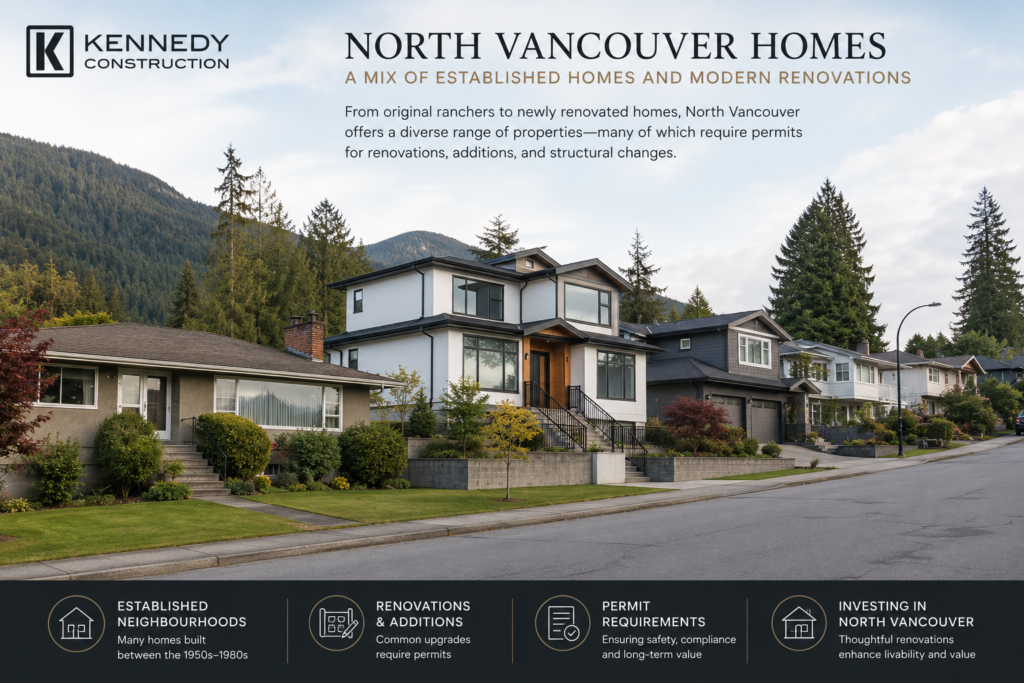
City vs. District: Why the Distinction Actually Matters
One of the first things homeowners get confused about is which municipality governs their property. The City of North Vancouver and the District of North Vancouver are entirely separate local governments with different building departments, different online permit portals, and different internal review timelines. An address on Lonsdale is processed through the City. A home in Lynn Valley or Deep Cove falls under the District.
This isn’t just administrative trivia. Submitting an application to the wrong authority means it won’t be processed at all, and you’ll lose whatever time you spent preparing it for the wrong portal. Before doing anything else, confirm your municipality using your property’s civic address through BC Assessment or the respective municipal website.
What Renovations Actually Require a Permit in North Vancouver?
Not every renovation triggers a permit requirement, but more do than most homeowners expect. The general rule is that any work affecting structural elements, fire separation, plumbing, gas lines, or electrical systems requires a permit. Cosmetic work, surface finishes, and like-for-like replacements often don’t.
Here’s a practical breakdown of common renovation scenarios:
| Renovation Type | Permit Required? | Notes |
| Kitchen cabinet replacement | No | Unless moving plumbing or gas lines |
| Load-bearing wall removal | Yes | Requires structural drawings |
| Secondary suite (basement) | Yes | Full building permit; zoning approval needed |
| Bathroom addition | Yes | Plumbing and building permit required |
| Deck over 600mm above grade | Yes | Structural review required |
| New windows (same opening) | No | Enlarging opening requires permit |
| Home addition or floor extension | Yes | Often triggers Development Permit too |
| Painting, flooring, trim | No | Purely cosmetic, no permit needed |
If your project involves multiple trades or a significant change to how the space functions, assume a permit is required and confirm with the building department. The cost of verifying is zero. The cost of assuming wrong can be substantial.
What Does the Permit Process Actually Look Like?
Understanding the sequence helps you predict your timeline and avoid the most common bottlenecks. Both North Vancouver municipalities follow a broadly similar review process, though internal timelines differ.
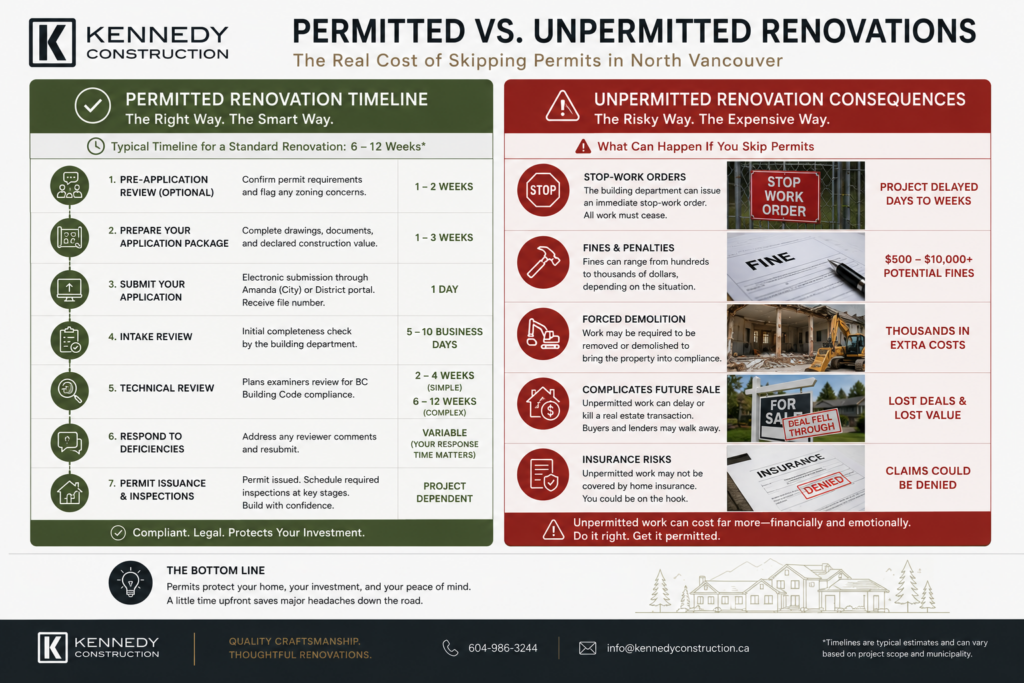
- Pre-Application Review (Optional but Valuable): Before submitting, you can contact the building department to confirm permit requirements and flag any zoning concerns. This step takes 1 to 2 weeks but often prevents a rejection later.
- Prepare Your Application Package: This includes site plans, floor plans, elevations, structural drawings where required, energy efficiency documentation, and a declared construction value. Incomplete packages are the number one reason for delays.
- Submit Your Application: Both municipalities accept electronic submissions. The City of North Vancouver uses a portal called Amanda. The District uses a separate system. You’ll receive a file number and confirmation of receipt.
- Intake Review: The building department does an initial completeness check, typically within 5 to 10 business days. If your package is incomplete, it gets returned at this stage, not reviewed.
- Technical Review: Plans examiners review the drawings for BC Building Code compliance. For simple renovations, this can take 2 to 4 weeks. For complex projects like secondary suites or structural additions, expect 6 to 12 weeks.
- Respond to Deficiencies: If reviewers flag issues with your drawings or documentation, you’ll receive a deficiency list. Your response time directly affects your overall timeline, and some applicants sit on these for weeks.
- Permit Issuance and Inspections: Once approved, you can begin work. Inspections are required at specific stages, such as framing, insulation, and final completion. Skipping an inspection stage means the next one won’t be approved.

How Much Do Building Permits Cost in North Vancouver?
Permit fees in both North Vancouver municipalities are calculated based on declared construction value, not square footage or project type. For residential renovations, the fee structure typically works out to roughly $10 to $20 per $1,000 of construction value, with minimum fees applying for smaller projects. A kitchen renovation declared at $60,000 in construction value would generate a permit fee in the range of $600 to $1,200. A $200,000 basement suite conversion could produce permit fees exceeding $2,500 to $4,000 depending on the fee schedule in effect.
Beyond the building permit fee itself, many projects also trigger technology levy fees, school site acquisition charges for additions that increase floor area, and plumbing or electrical permit fees administered separately by Technical Safety BC. It’s not uncommon for a homeowner to budget for the building permit and then be surprised by $300 to $800 in additional fees they weren’t expecting.
| Project Type | Estimated Construction Value | Approximate Permit Fee Range |
| Bathroom renovation | $20,000–$45,000 | $300–$700 |
| Kitchen renovation | $50,000–$120,000 | $700–$1,800 |
| Secondary suite | $80,000–$200,000 | $1,200–$4,000 |
| Home addition | $150,000–$400,000+ | $2,500–$7,000+ |
| Structural wall removal | $15,000–$40,000 | $250–$600 |
These ranges are estimates based on typical fee structures and should be verified directly with the relevant building department. Fee schedules are updated periodically, and construction value assessments can be challenged if your declared value seems inconsistent with market rates for the work being done.
What Actually Causes Permit Delays?
The most common cause of permit delays in the Metro Vancouver region is incomplete or non-compliant drawing packages submitted at intake. Applications returned for missing information can add 3 to 6 weeks to the overall timeline, since the applicant must revise and resubmit, and the application re-enters the review queue rather than resuming where it left off. Building departments in North Vancouver have reported that a significant portion of first submissions require at least one round of revisions before approval.
Beyond incomplete drawings, several other factors regularly slow things down:
- Zoning conflicts: If your renovation or addition exceeds setback rules, height restrictions, or floor space ratio limits, your application may require a variance or rezoning process before the building permit can proceed. This adds months, not weeks.
- Heritage designation: Homes in certain North Vancouver neighbourhoods with heritage status require additional review. Even interior renovations can trigger heritage assessment if they affect character-defining elements.
- Engineer delays: Structural drawings from a licensed engineer are required for load-bearing changes and many additions. If your engineer is backed up, your drawings arrive late, and the whole schedule shifts.
- High application volumes: Spring and early summer are peak permit periods. Applications submitted in March or April compete with many others in the review queue, slowing average processing times across the board.
- Slow deficiency responses: When the building department sends back a deficiency list, the clock stops until you respond. Some homeowners or contractors take 2 to 4 weeks to address comments that could have been resolved in days.
For projects that intersect with larger home investments, understanding timelines upfront makes the whole process less stressful. A kitchen renovation guide can help you map out what’s realistic from planning through permit approval to final installation, particularly when multiple trades are involved.
Common Mistakes Homeowners Make With Permits
- Underestimating construction value: Some homeowners declare a lower construction value to reduce permit fees. Building departments compare declared values against cost benchmarks. Undervaluation can result in fee adjustments, delays, or flags on future work.
- Starting work before permit issuance: This is one of the most damaging mistakes. Inspectors can and do issue stop-work orders, which freeze the project until compliance is confirmed. In some cases, completed work must be opened up for inspection.
- Assuming your contractor pulled the permit: Unless it’s explicit in your contract and you have a permit number in hand, don’t assume. Confirm directly with the building department.
- Ignoring the inspection schedule: A permit without completed inspections is an open permit. Open permits appear on title searches and can complicate mortgage renewals, refinancing, and home sales.
- Forgetting about trade permits: The building permit covers the structural and architectural scope. Electrical and gas work require separate permits administered by Technical Safety BC. These are often missed.
For homeowners planning larger structural work or additions, reviewing home addition ideas alongside your permit strategy helps avoid scope creep that triggers additional review requirements mid-project.
How Permit Timelines Compare Across Project Types
Based on typical processing times at North Vancouver building departments, straightforward renovation permits for bathrooms or non-structural kitchen work take approximately 3 to 6 weeks from complete submission to approval. Secondary suite permits average 8 to 16 weeks when applications are complete and meet all zoning requirements. Complex projects involving structural additions or variance requests can take 4 to 8 months or more from initial submission to permit issuance, particularly when council approval or public notice periods are triggered.
One thing experienced contractors learn quickly is that timelines are highly sensitive to submission quality. A clean, well-prepared set of drawings reviewed by an experienced plans examiner can move through faster than the average timeline suggests. The inverse is equally true: a package that goes back and forth twice adds 8 to 12 weeks before you’ve broken ground.
If you’re thinking about a custom home timeline in West Vancouver, the same principle applies: front-loading the preparation work is consistently the highest-value use of pre-construction time.
Working With a Contractor Who Manages the Permit Process
There’s a practical difference between a contractor who says “we handle permits” and one who has an established process for it. The latter typically has relationships with the building department, understands what plans examiners look for, and knows how to structure drawing packages that move through review efficiently.
For homeowners, the key question to ask any contractor is: who is the permit applicant, and who manages deficiency responses? If the answer is unclear, that’s a signal worth paying attention to before signing a contract. A delay in the permit phase is almost always more expensive in the long run than the cost of getting it right the first time.
Teams working on modern custom homes in West Vancouver approach permitting as part of the design and preconstruction phase, not as a separate administrative task. That integration is what keeps complex projects on schedule.
Frequently Asked Questions
Do I need a permit for a simple kitchen renovation?
It depends on what “simple” means for your specific project. Replacing cabinets, counters, and appliances in the same locations typically doesn’t require a permit. If you’re moving the sink, relocating gas lines, adding an island with electrical, or removing a wall between the kitchen and another room, a permit is required. When in doubt, a quick call to the North Vancouver building department confirms the requirement before you start planning.
How do I submit my permit application?
Both the City and District of North Vancouver accept electronic permit applications through their respective online portals. You’ll need a complete drawing package, a completed application form, and a declared construction value. It’s worth calling the building department ahead of your submission if it’s your first time, as requirements for drawing detail can vary by project type and the intake review will catch missing items anyway.
What happens if I work without a permit?
Working without a required permit creates several problems that outlast the renovation itself. The building department can issue a stop-work order at any point, halting your project until compliance is confirmed. Completed work may need to be exposed for inspection, which means opening up walls or ceilings. When you eventually sell your home, a title search reveals open or missing permits, which can delay or derail a sale and reduce your negotiating position. The financial exposure from working without a permit almost always exceeds the cost of obtaining one properly.
How are permit fees calculated?
Permit fees in North Vancouver are based on the declared construction value of the work being done. Each municipality has a published fee schedule with rates per $1,000 of construction value, usually with minimum fees and tiered rates as values increase. Additional fees can apply for technology levies, development cost charges if you’re adding floor area, and separate trade permits for electrical or gas work through Technical Safety BC. The building department can provide a fee estimate before you submit.
How long does it take for a permit to be approved?
Processing times depend heavily on project complexity and the quality of your submission. Straightforward renovation permits with complete applications typically take 3 to 8 weeks. Secondary suite conversions and structural projects can take 10 to 16 weeks or more. Home additions that require variance hearings or development permits can extend timelines to several months. Submitting a complete, well-prepared package and responding quickly to any deficiency requests are the two most controllable factors in your timeline.
Final Thoughts and Next Steps
Permits aren’t the most exciting part of a renovation, but they’re one of the most consequential. Getting the process right protects your investment, keeps your project on schedule, and ensures that the work you’re paying for can be legally sold and insured down the road.
The homeowners who navigate this smoothest are the ones who start the permit process early, submit complete packages, and work with contractors who treat permitting as a core part of their service rather than an afterthought.
If you’re planning a renovation in North Vancouver and want to work with a team that handles the permit process from the start, Kennedy Construction has worked on residential projects across the North Shore. Reach out at 604-986-3244 to talk through your project scope, timeline, and what the permit process will realistically look like for your specific renovation.