Yes, you can absolutely build a custom home on a sloped lot in West Vancouver, and many of the area’s most striking residences sit on exactly that kind of terrain. However, the gradient introduces real engineering demands, permitting complexity, and cost premiums that flat-lot projects simply don’t face. Understanding what drives those costs and how skilled designers work with the slope rather than against it is the difference between a successful build and a budget disaster.
West Vancouver’s hillside topography is one of its defining features. From Dundarave up through Chartwell and the British Properties, the landscape rises steeply toward the mountains, and the lots that come with those views almost always come with a grade. If you’re holding title to one of those properties or considering buying one, the question isn’t really whether you can build. It’s whether you understand what you’re getting into before the first excavator arrives.
Key Takeaways
- Sloped lot construction in West Vancouver typically adds $50,000 to $200,000 or more to a project budget compared to a flat site, primarily through excavation, retaining walls, and foundation engineering.
- The steeper the grade, the more your architect and structural engineer become the most important people on the project, not the framer or the finisher.
- West Vancouver’s District of West Vancouver requires geotechnical assessments on slopes exceeding certain grades, which adds both time and cost to the pre-construction phase.
- Design strategies like split-level layouts, cantilevered floors, and daylight basements can convert slope liabilities into premium living features.
- Drainage and soil stability are the two factors most commonly underestimated by homeowners on sloped sites, and both can derail a project mid-build if not addressed early.
- Working with a builder experienced in West Vancouver’s specific terrain and permitting environment significantly reduces costly surprises.
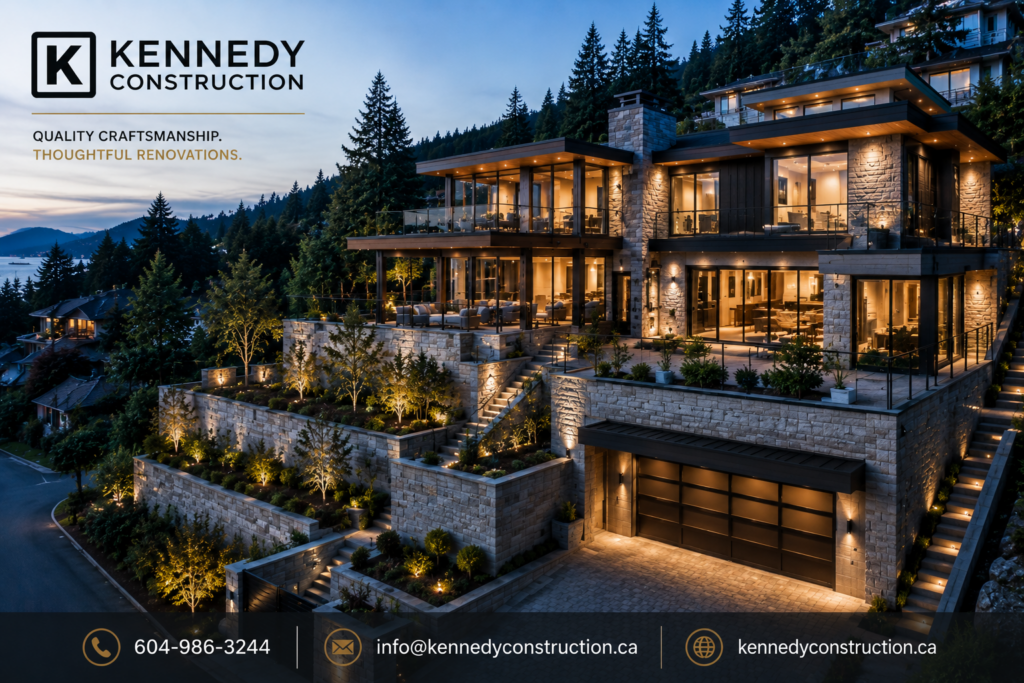
Why Sloped Lots in West Vancouver Are Both an Opportunity and a Challenge
There’s a reason the most coveted addresses in West Vancouver sit on hillsides. The views across Burrard Inlet, toward downtown Vancouver and the islands beyond, are simply not available from flat ground. Buyers pay a significant premium for that elevation. What they’re often less prepared for is what that elevation costs to build on.
A slope changes nearly every phase of construction. Site preparation is more complex. Foundation design shifts from a standard perimeter pour to something engineered specifically for the bearing conditions of that soil and that grade. Drainage has to be actively designed rather than assumed. Even the logistics of getting materials on site becomes a planning exercise when your lot drops or climbs sharply from the street.
That said, none of this makes a sloped lot a bad choice. In skilled hands, terrain that looks like an obstacle on paper becomes the architectural feature that makes a home memorable. The question is whether your project team has the right experience to turn that into reality.
What Does It Actually Cost to Build on a Sloped Lot?
In Metro Vancouver, custom home construction on a flat lot typically runs between $400 and $600 per square foot for mid-to-high-end finishes. On a sloped lot in West Vancouver, that figure can climb to $500–$750 per square foot or higher, depending on the steepness of the grade, the soil conditions, and how extensively the design engages with the terrain. The slope premium itself, covering excavation, engineered foundations, retaining walls, and drainage systems, often adds between $80,000 and $250,000 to the total project cost before you’ve chosen a single finish.
What makes those numbers move so dramatically is the variability in site conditions. Two lots on the same street can have vastly different subsurface geology. One might have solid bedrock close to the surface, which simplifies foundation work but dramatically raises excavation costs. Another might have deep soil with high moisture content, requiring more extensive drainage and potentially a deeper or wider foundation footprint.
Retaining walls alone, which are often necessary to stabilize the uphill side of a sloped build, can cost between $300 and $700 per linear foot depending on the material, height, and engineering requirements. A home requiring 60 linear feet of engineered concrete retaining wall is looking at $18,000 to $42,000 for that element alone, before any other slope-related costs are factored in.
Slope-Related Cost Breakdown at a Glance

How Do Architects and Builders Actually Design for a Slope?
The best hillside homes in West Vancouver don’t fight the terrain. They follow it. An experienced architect working with a competent builder treats the slope as a design asset rather than a liability. That shift in thinking is what separates a home that feels naturally rooted in its site from one that looks like it was dropped onto a hillside as an afterthought.
Several design strategies come into play on sloped lots, and the right combination depends heavily on the direction of the slope, the ratio of grade, and the client’s goals for how the home engages with the landscape.
Split-Level and Staggered-Floor Layouts
On lots with a moderate grade, split-level layouts allow the home to step down the hillside in a way that feels intentional. Each level can have its own relationship to the outdoor grade, creating opportunities for walkout decks, lower-level gardens, and views that shift as you move through the home. This approach typically costs less than a full excavation because you’re working with the slope rather than cutting through it.
Daylight Basements
A slope that drops from front to back allows for a daylight basement, where the lower level opens fully to the downhill side with full-height windows and exterior access. What would be a dark, subterranean space on a flat lot becomes a bright, usable floor with its own outdoor connection. Many West Vancouver homeowners use this level as a suite, a studio, or an entertainment space, and it adds functional square footage at a lower per-square-foot cost than above-grade construction.
Cantilevered Structures
On steeper grades, cantilevering a section of the home over the slope allows the structure to reach toward the view without requiring massive excavation below. This is structurally demanding and requires a highly engineered solution, but the result is a home that appears to float over the hillside. It’s a signature look in West Vancouver’s contemporary residential architecture, and it’s one of the features that makes modern custom homes in this area so architecturally distinct.
Step-by-Step: How a Sloped Lot Build Unfolds in West Vancouver
- Geotechnical investigation: Before any design work can be finalized, a geotechnical engineer assesses the soil conditions, bearing capacity, and slope stability. This report drives foundation design and is typically required by the District of West Vancouver for permits on sloped sites.
- Architectural and structural design: The architect develops the design in close collaboration with a structural engineer to ensure the building envelope works with the site’s topography. Decisions made at this stage directly determine excavation scope and retaining wall requirements.
- Permitting: West Vancouver’s Development and Building Services reviews the application, which on sloped lots often involves additional scrutiny around drainage, setbacks, and slope stability compliance. Understanding the custom home build timeline helps set realistic expectations, since permitting on a sloped lot can take longer than a standard application.
- Site preparation and excavation: This is often the most unpredictable phase. The excavation crew works against what the geotechnical report predicted, and surprises in subsurface conditions can add cost and time if not handled by an experienced team.
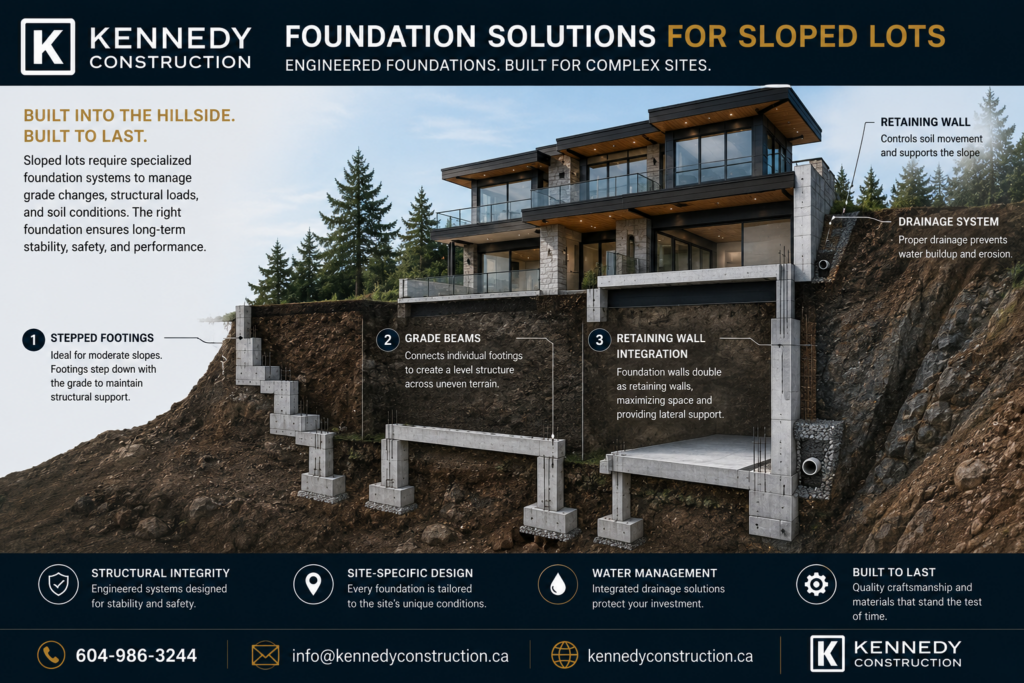
- Foundation and retaining wall construction: Foundations on sloped sites often involve stepped footings or a combination of poured concrete walls and grade beams. Retaining walls are typically built concurrently, as they form part of the structural system.
- Drainage installation: A comprehensive drainage plan, including perimeter drains, French drains, and surface grading, is installed before backfilling. Getting this wrong is one of the most expensive mistakes a builder can make on a hillside.
- Framing and above-grade construction: Once the site is prepared and the foundation is in, the build proceeds much like any other custom home, with the added complexity of coordinating multi-level access for materials and trades.
What Are the Structural Challenges Specific to Sloped Sites?
Lateral soil pressure is a force that flat-lot builders rarely have to think about, but it becomes a primary engineering concern on sloped sites. The weight of soil pressing horizontally against foundation walls and retaining structures has to be calculated and counteracted by the structural design. In seismic zones like Metro Vancouver, this calculation also has to account for dynamic loads during an earthquake, which can amplify lateral forces significantly.
Drainage failure is the silent threat on sloped lots. Water that isn’t intercepted and redirected will find the path of least resistance, and on a hillside, that path often runs directly under or through a building’s foundation. Poor drainage is the root cause of a significant share of the structural failures and costly remediation projects on hillside homes in the Lower Mainland. It’s also a problem that’s far cheaper to design out than to fix after the fact.
In the District of West Vancouver, lots with a natural grade exceeding 20% typically require a geotechnical report as a condition of building permit approval. Lots exceeding 30% grade may trigger additional review under the district’s Hillside Development Guidelines, which can restrict building footprint, require specific foundation types, and impose limits on cut-and-fill volumes.
Common Mistakes to Avoid When Building on a Sloped Lot
- Skipping or skimping on the geotechnical report. Some owners try to save money here. The report costs a fraction of what a drainage failure or foundation problem costs to remediate, and it’s required by permit in most cases anyway.
- Choosing a builder without hillside experience. A contractor who builds beautifully on flat lots may have never managed the sequencing, water management, and engineering coordination that a sloped site demands. Check references specific to slope builds, not just custom home builds generally. Reviewing mistakes to avoid when planning your build can save significant time and money.
- Underestimating excavation costs. Until you hit the ground, you don’t know exactly what’s under it. Budget contingencies of 15–20% for site work on sloped lots are not excessive; they’re prudent.
- Treating drainage as an afterthought. The drainage plan should be part of the structural design conversation from day one, not something added at the end when the grade work is almost done.
- Ignoring neighbour and property line impacts. Cut-and-fill operations and retaining walls near property lines can affect neighbouring lots. Setback requirements and BC’s Land Title Act create real constraints that need to be addressed in the design phase, not during construction.
- Over-designing for views at the expense of livability. A home perched dramatically on a slope but with difficult interior circulation, poor natural light on lower levels, or impractical access from the street is not a successful build, regardless of how it photographs.
How Does This Compare to Building in Nearby Areas?
West Vancouver’s terrain is steep and consistent, which means the challenges described here apply broadly across the municipality. North Vancouver, particularly the upper elevations of Lynn Valley, Grouse Woods, and the District of North Vancouver hillsides, presents similar conditions, though the permitting environment and municipal guidelines differ. If you’re comparing projects across these areas, understanding home renovation cost in North Vancouver versus a ground-up sloped build in West Vancouver helps contextualize what you’re committing to.
| Area | Terrain Profile | Slope Complexity | Key Consideration |
| West Vancouver (British Properties, Chartwell) | Steep, consistent | High | Hillside Development Guidelines |
| North Vancouver (Lynn Valley, upper slopes) | Moderate to steep | Moderate to High | Varied soil, creek proximity |
| West Vancouver (Dundarave, Ambleside) | Gentle to moderate | Low to Moderate | Infill lots, existing infrastructure |
| Squamish (hillside lots) | Variable | Moderate | Rock outcrops, lower lot cost |
Frequently Asked Questions
Does it cost more to build on a sloped lot?
Yes, building on a sloped lot consistently costs more than building on flat ground. The primary cost drivers are excavation, engineered foundations, retaining walls, and drainage systems. In West Vancouver, the slope premium can range from $80,000 to $250,000 or more depending on the grade and soil conditions, though that cost is often offset by higher property values and the premium views that hillside lots provide.
How much does it cost to build a custom home in Vancouver?
Custom home construction in the Greater Vancouver area generally ranges from $400 to $700 per square foot for mid-to-high-end finishes, with luxury or architecturally complex builds in West Vancouver reaching $800 to $1,200 per square foot or higher. These figures typically exclude land, soft costs (design, permits, engineering), landscaping, and site-specific premiums like those associated with steep-slope construction.
What is the most expensive part of building a house?
On a typical flat-lot custom home, framing and structural work tends to represent the largest single cost category, followed closely by mechanical systems (HVAC, plumbing, electrical) and exterior envelope work. On a sloped lot, site work and foundation engineering can displace framing as the most expensive phase, particularly when extensive excavation, engineered retaining walls, and custom drainage systems are required.
How close can you build to a property line in BC?
Setback requirements in BC are set by individual municipalities, not a single provincial standard. In the District of West Vancouver, minimum setbacks for residential construction are typically 6 metres from the front property line, 1.2 to 1.5 metres from side lot lines, and 6 metres from the rear lot line, though these vary by zone and lot configuration. On sloped lots, retaining walls near property lines may be subject to additional height and proximity restrictions.
How close to my property line can I build?
The specific answer depends on your zoning designation and lot configuration. In West Vancouver, you should request a zoning confirmation letter from the District or consult with a land use consultant as part of your pre-design process. Building closer to a property line than permitted, even unintentionally, can result in stop-work orders, costly redesigns, or demolition orders. On sloped lots where retaining walls may extend near lot boundaries, this review is especially important before finalizing your design.
Final Thoughts on Building on a Sloped Lot in West Vancouver
A sloped lot in West Vancouver is not a compromise. It’s an invitation to build something that couldn’t exist anywhere else. The views, the relationship to the landscape, the architectural possibilities that only grade can create, these are the reasons people seek out these properties in the first place.
But none of that comes without genuine complexity. The engineering demands are real, the costs are higher, and the margin for error is smaller than on a flat site. The homeowners who get the best outcomes are the ones who go in with clear expectations, a realistic budget that accounts for the slope premium, and a builder who has done this work before on this kind of terrain.
If you’re planning a custom home on a sloped lot in West Vancouver or the surrounding North Shore, Kennedy Construction has the experience to guide you through the process from geotechnical assessment to final finishes. Call the team at 604-986-3244 to start a conversation about your site and what a well-executed hillside build can look like for your family.